
Last updated:
Hewlett-Packard: A Platform Strategy for Global Spare Parts Ecommerce
Ecommerce platform strategy and future-state architecture advisory for HP Parts Store, comparing continued custom development against Adobe Commerce, Shopify Plus, and Salesforce Commerce Cloud
Project Summary
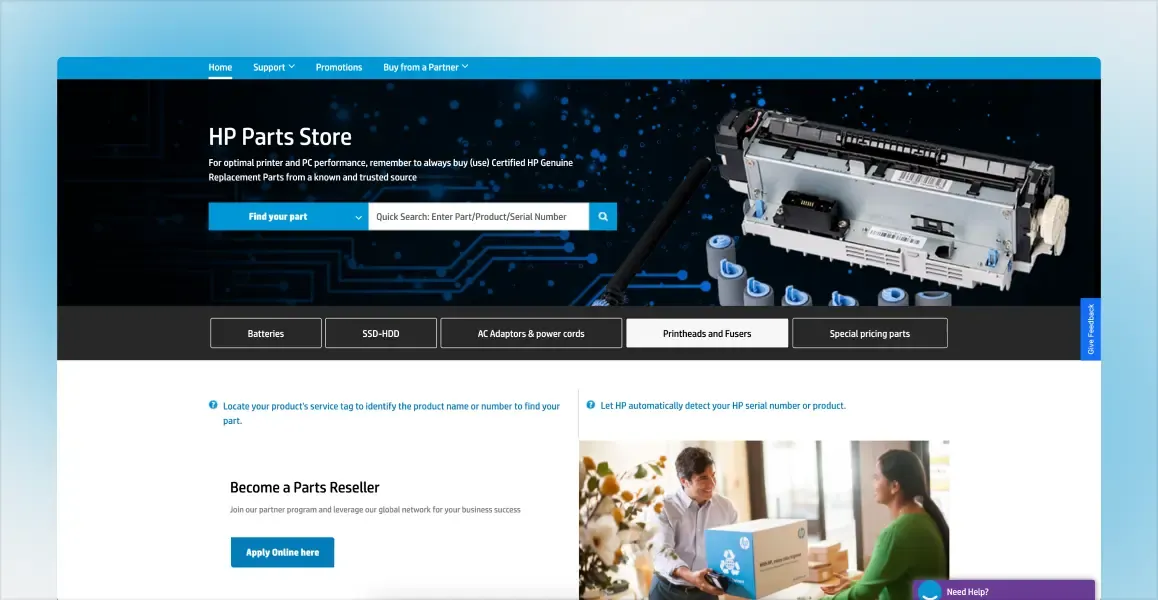
Hewlett-Packard runs the HP Parts Store, a global channel through which customers and partners order replacement components for HP devices. As scaling demands grew, HP faced one strategic question before committing further budget: keep extending a fully custom ecommerce architecture, or move to an enterprise platform built for global scale.
Elogic Commerce was engaged as the strategic partner to answer it. Rather than begin a build, we built the platform strategy first: an evidence-based comparison of architecture paths that leadership could act on with confidence. The work combined application landscape analysis, business capability mapping, TCO modeling, and future-state scenario planning into a single strategic asset, turning a technical question into a board-level investment decision with quantified trade-offs.
Key Outcomes
4
enterprise platforms evaluated
60+
business & technical requirements documented
25+
enterprise integrations assessed
3
future-state architecture scenarios modeled
30-40%
estimated long-term development cost reduction
About the Client
Hewlett-Packard runs multiple digital commerce platforms across global markets. The HP Parts Store serves direct customers and channel partners who need the correct replacement components for HP hardware. Because the catalog spans many device generations, its complexity goes well beyond typical accessory ecommerce, with serial-number compatibility, product relationships, replacement eligibility, and fulfillment logic tightly coupled to the underlying architecture.
Strategic Context
The decision facing HP was not which features to build but which future to invest in. A functioning custom platform made the choice harder, not easier: it still worked, yet its long-term fit was unproven. Any direction was a multi-year commitment touching order management, fulfillment, and partner operations at once, and it called for a future-state architecture proven before further capital was committed. With 25+ systems already integrated, that decision could not be made on instinct.
Business Challenge
Beneath the strategic question sat three concrete risks.
01
Strategic uncertainty
Leadership needed an evidence-based platform recommendation rather than internal opinions, with engineering, procurement, and business stakeholders each weighing risk differently.
02
Rising cost of ownership
Every new feature on the custom platform demanded proportionally more engineering effort than HP wanted to sustain, with no clear view of whether the architecture could scale with global growth.
03
Investment confidence
Without a documented comparison and a sequenced plan, any budget decision would carry avoidable risk across a program of this scale.
Consulting Approach
Requirements and Application Landscape Analysis
We began by mapping HP’s existing application landscape, catalog structure, ordering workflows, integrations, and scalability needs, into a framework of 60+ business and technical requirements. This became the shared reference point for every comparison, anchoring the strategy to what HP actually needed rather than vendor feature lists.
Custom vs. Platform Comparison
We then built a side-by-side comparison of continued custom development against enterprise platforms, modeling total cost of ownership, time-to-market, infrastructure, and long-term flexibility. Four options were assessed against the same framework, so the recommendation could be defended on evidence rather than preference.
Future-State Architecture Scenario Modeling
Because platform decisions are rarely binary, we modeled three future-state paths, fully custom, hybrid, and full platform transition, each with its own cost, timeline, and risk profile. This gave HP a spectrum of directions rather than an all-or-nothing choice.
Strategic Roadmap and Governance
We packaged the strategy for the board: a platform comparison report, future-state architecture recommendations, phased transformation roadmap scenarios, projected cost models, and architecture governance principles for how the platform estate should evolve after any transition.
Results and Business Impact
Executive Alignment
Established
by leadership, a shared decision framework let engineering, procurement, and business stakeholders evaluate options against the same requirements and financial assumptions.
Financial Planning
30-40%
reductions in long-term development costs were projected by the TCO analysis under selected platform adoption scenarios.
Risk Reduction
25+
enterprise integrations were analyzed, exposing migration dependencies before implementation planning and reducing execution risk.
Strategic Direction
+
Three future-state scenarios gave leadership phased investment options instead of a binary build-versus-buy decision.
Capabilities Demonstrated
When This Strategy Fits
This kind of engagement fits when an organization suspects its architecture is nearing its limits but lacks the evidence to justify a multi-year investment, when stakeholders disagree on the path forward, or when the cost of guessing wrong warrants setting direction first.
It fits less well where the mandate is already clear and only execution remains, where a simpler catalog needs only a light assessment, or where an urgent technical failure makes immediate stabilization the priority.
Planning an Ecommerce Platform Strategy?
Successful platform transformations are rarely limited by technology; they succeed when leadership aligns around the right strategy, architecture, and investment case before implementation begins. Elogic Commerce partners with executive teams to define that direction and reduce transformation risk before significant delivery investment is made.