

Headless Ecommerce Development
Headless ecommerce decouples the storefront from the platform, letting you ship frontend changes without touching the backend. The risk shifts: less theme-engineering pain, more API and integration discipline. We build headless and composable storefronts on Adobe Commerce, Shopify Plus, BigCommerce, and Salesforce Commerce Cloud — including PWA, composable architectures with commercetools, and B2B headless implementations where account-specific pricing must travel through the API layer.
Headless commerce is not automatically the right answer. See why Elogic Commerce is a fit for headless commerce delivery and how Elogic Commerce decides when headless architecture creates real business advantage — and when it adds cost and complexity without proportional return.


Our Case Studies
Fashion to publishing, industrial automation to gift cards — headless ecommerce development will be the right fit no matter the niche you operate in. Check out a few success stories!

ISO 9001 and 27001-aligned processes for quality and security management.
Why businesses choose us
Built for High-Stakes Commerce: Trusted for enterprise replatforming, complex B2B pricing structures, performance optimization initiatives, and recovery of stalled or failed implementations.

Mid-Market to Enterprise Commerce Specialists:
We design, build, and scale complex B2B and D2C commerce ecosystems for growing mid-market companies and enterprise organizations operating across multiple regions, brands, and business models.

Platform-Certified Across All Core Ecosystems We Support:
Adobe Commerce Silver Solution Partner, Shopify Plus Partner, and Hyvä Bronze Partner — with certified engineers across every platform we implement, ensuring validated expertise rather than generalist development.

Strategic Discovery & Commerce Consultancy:
Structured discovery engagements including stakeholder workshops, technical audits, architecture assessments, total cost of ownership modeling, roadmap definition, and implementation risk analysis before development begins.

PMI-Aligned Project Governance:
Delivery aligned with PMI standards and led by PMP-certified project managers, incorporating sprint governance, risk registers, milestone tracking, and transparent executive reporting.
ISO-Aligned Quality & Secure SDLC:
Delivery processes aligned with ISO quality management principles, secure SDLC practices, formal QA frameworks, code review protocols, and controlled release management.

Certified QA & Engineering Excellence:
ISTQB-certified QA engineers executing structured test strategies, regression control, performance validation, and enterprise-grade release confidence.

Enterprise Integration Depth:
Proven ERP integrations including SAP, Microsoft Dynamics, NetSuite, Infor, Epicor, and Odoo, alongside CRM, PIM (e.g., Akeneo, Pimcore), OMS, WMS, and payment ecosystems.

Advanced B2B & Procurement Capabilities:
Implementation of cXML punchout catalogs, procurement integrations (e.g., Ariba), vendor portal development, contract pricing logic, approval workflows, account hierarchies, and complex B2B commerce environments.
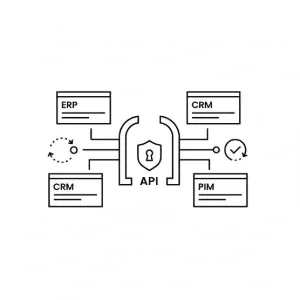
Data Platforms & Governance Architecture:
Secure API orchestration, BI/data platform integration, real-time synchronization, role-based access control, auditability, and compliance-aware data flows across ERP, CRM, and PIM systems.
Structured CX & Creative Frameworks:
Customer journey mapping, persona-driven UX design, CRO experimentation models, and performance-first storefront architecture including Hyvä and headless builds.

Independently Rated 5.0 on Clutch:
Clients consistently cite on-time delivery, proactive communication, and strong technical leadership across complex enterprise engagements.

500+ Commerce Projects Delivered:
17+ years of experience with 200+ in-house ecommerce specialists executing multi-store, multi-region, B2B, D2C, and composable commerce architectures.
Benefits of headless ecommerce development
Separating front-end presentation from back-end execution can be a powerful approach, especially for enterprise-level and digitally mature businesses. With a trusted technology partner like Elogic Commerce by your side, you can start reaping the benefits of headless commerce from the first day of the solution implementation.


What our clients are saying

If we experience an issue at any time, Elogic Commerce is accessible and quickly handles the problem.

CEO, Dampfi

They only accept jobs that they know that they can do, and are good at managing expectations.

Managing Director, Yellowblue

The team’s general technical knowledge and Magento expertise distinguish them from other providers.

Technical Lead, Instant ECARE
Industries we build for
Let’s talk
Whatever concept you have in mind, we have an idea or two on how to implement it within the existing budget and timeframe as efficiently as possible. Consider us your one-stop, platform-agnostic software partner.


Ready to chat?
Reach out to receive a free consultation and entrust your IT initiative to a company that will help you manifest your vision and business approach into an ever-growing and adaptable business.
Headless Ecommerce Development Near Your Market
Work with Elogic Commerce across key locations in Europe, the UK, and the US. Explore our regional ecommerce development expertise for Adobe Commerce, Shopify Plus, BigCommerce, Salesforce Commerce Cloud, B2B ecommerce, migrations, integrations, and ongoing support.
Frequently asked questions
Headless commerce architecture decouples the storefront (frontend, presentation layer) from the commerce platform (backend, business logic) using APIs as the contract between them. The storefront can be built in any frontend technology (React, Vue, Next.js) and can be replaced or redesigned without modifying the backend platform. The backend handles catalog, cart, checkout, and order management; the storefront handles presentation, user experience, and merchandising. PWAs (Progressive Web Apps) are the most common headless storefront pattern.
The clearest signals: frontend performance ceilings on a monolithic platform that performance optimization cannot resolve, multiple storefronts (multi-region, multi-brand) on the same backend, requirement for advanced merchandising or personalization the platform’s native theme engine cannot deliver, or strategic intent to keep the frontend evergreen while the backend platform stabilizes. Headless rarely pays back for low-complexity storefronts where the platform’s native theme is sufficient.
The honest tradeoffs: higher initial build cost than monolithic platforms, more operational complexity (multiple deployment pipelines, monitoring across services), API and integration reliability becomes the single point of failure rather than theme performance, and the team needs frontend engineering depth that monolithic platforms don’t require. Headless is the right choice for organizations with the engineering team and operational maturity to absorb that complexity — and the wrong choice for those without.
Elogic Commerce delivers headless architecture on Adobe Commerce (Magento), Shopify Plus, BigCommerce, Salesforce Commerce Cloud, and commercetools. For front-end development, we work with React, Next.js, Vue.js, and Nuxt, integrated with headless CMS platforms including Contentful, Strapi, and Adobe Experience Manager.
A mid-market headless implementation — decoupled storefront on an existing commerce backend with standard API integrations — typically takes 4–8 months. Enterprise headless projects involving multi-channel delivery, complex CMS integration, custom B2B front-end requirements, and full migration from a coupled theme may take 8–14 months. Timeline is confirmed after architecture design and scoping.
Elogic Commerce provides structured post-launch support for headless environments — covering front-end performance monitoring, API integration maintenance, commerce backend updates, security patching, and feature development. We offer both reactive time-and-materials support and proactive SLA-backed managed support retainers for organizations requiring ongoing operational capacity.
We cover unit, integration, and end-to-end testing plus performance and security checks when required, ship with staged rollout and rollback readiness, and define ownership for merchandising, CRO, content ops, and analytics with backlog governance and monitoring so the system improves after launch rather than degrading.
Headless commerce decouples the frontend from the backend. Composable commerce goes further: it decouples the backend itself into independent best-of-breed services — a dedicated catalog service, a dedicated checkout service, a dedicated order management service, etc. — each replaceable independently. Composable architectures are typically built on platforms like commercetools that are designed for this orchestration. Most composable architectures are also headless, but not all headless architectures are composable.
A focused headless build on an existing commerce platform typically runs 4–8 months. Composable architectures with multiple best-of-breed services orchestrated together typically run 9–18 months. Timeline is driven by integration count, frontend ambition, and the maturity of the team that will own the architecture post-launch.
In traditional ecommerce, the front-end (what customers see) and the back-end (catalog, cart, checkout, orders) are tightly coupled in a single platform codebase. Headless ecommerce separates them: the front-end is built independently using modern web frameworks, and it communicates with the commerce backend through APIs. This separation gives teams more control over storefront performance, content delivery, and front-end technology choices — but requires more architectural discipline and development investment than a coupled approach. Not sure which platform to build on? Compare the best headless commerce platforms.
Yes, in specific circumstances. Headless architecture is well-suited to B2B operations with complex front-end requirements: account-specific catalog rendering, customer-specific pricing display, complex product configurators, or multi-channel ordering interfaces that a platform-native theme cannot deliver efficiently. However, for B2B operations where front-end performance is adequate and development resources are limited, a well-optimized platform theme may be a more cost-effective choice. Elogic Commerce advises on this trade-off before recommending a headless approach.
Yes. Elogic Commerce delivers migrations from coupled platform themes to headless architecture — including Adobe Commerce (Magento) Luma/Blank to headless, Shopify to Shopify Plus headless, and legacy theme migrations. Migration includes front-end rebuild, API layer design, CMS integration, performance validation, and SEO-safe cutover. This can also be scoped as part of a broader ecommerce replatforming engagement.
Yes, as long as identity, roles/permissions, and pricing/catalog rules are designed with clear integration ownership; for PunchOut, EDI, or CPQ, we validate requirements early because they directly shape architecture, data contracts, and release risk.
Headless is not a fit when requirements are standard, the team cannot support the added operational complexity, or the budget doesn’t allow proper testing, monitoring, and ongoing maintenance—then a simpler architecture often delivers better ROI with lower risk.
You may also like
Discover additional services that can help enhance your ecommerce strategy and support your business growth.

Technical Specifications
| Service category | Headless/Composable Commerce • Replatforming • Integrations • Managed Services |
|---|---|
| Architecture capability | Monolith → composable migration • MACH-ready architecture |
| Primary composable platform partner | commercetools |
| Certified bench (selected) | 15 commercetools-certified engineers • 10 ISTQB-certified QA • PMP-certified PMs |
| Supported commerce platforms | Adobe Commerce (Magento) • Shopify Plus • SFCC • BigCommerce • commercetools |
| Integrations (common) | SAP • Microsoft Dynamics 365 • NetSuite • Salesforce • Visma.net/Visma Business |
| PIM experience | inriver • Akeneo • Pimcore |
| Support model | Managed services with SLA + 24/7 support |
| Commercials | Min project size: $50,000+ • Avg hourly rate: $50–$99/hr |
| Company facts (directory-ready) | Founded 2009 • Employees 50–249 • Locations: Dresden (Germany), Prague (Czech Republic) |
| Service coverage | Language: English • Timezones: EST, EET, MET, PST |