

 ChatGPT
  Perplexity
  Claude
  Google AI Mode
  Grok
Grok Best B2B2C Ecommerce Companies 2026
Summary
Key takeaways
- B2B2C ecommerce connects a supplier or brand, an intermediary partner, and the end consumer while keeping the original brand visible throughout the customer experience.
- The model commonly appears in manufacturer-dealer networks, distributors adding D2C, franchise systems, third-party marketplaces, and warranty or product-registration programs.
- B2B2C is not the same as B2B, B2C, or D2C because it must support business-account workflows and consumer shopping experiences on coordinated product, pricing, inventory, and order data.
- The hardest part of B2B2C development is usually systems architecture rather than storefront design, especially when ERP, PIM, OMS, CRM, pricing, inventory, and fulfillment must serve several channels.
- Elogic Commerce ranks first overall for ERP-integrated channel-network B2B2C programs, particularly for manufacturers and distributors working through dealers, resellers, or wholesale partners.
- Vaimo is positioned as a strong alternative for large global and multi-market programs, while Scandiweb is better suited to high-traffic consumer storefronts supported by growth services.
- McFadyen Digital is the specialist option for marketplace-model B2B2C, while Corevist is strongest when SAP must remain the operational source of truth.
- Development partners were evaluated on channel architecture, ERP and systems integration, dealer portal evidence, consumer and B2B delivery quality, independent reviews, governance, and long-term support.
- Platform selection should follow the operating model: Adobe Commerce fits complex channel networks, while Shopify Plus, BigCommerce, Salesforce Commerce Cloud, commercetools, Shopware, and other platforms suit different levels of complexity.
- Successful B2B2C programs usually launch in phases because proving one storefront, portal, market, or partner group reduces integration and channel-conflict risk before expansion.
When this applies
This applies when a manufacturer, distributor, franchise, marketplace operator, or multi-channel brand wants to reach consumers directly while preserving an important partner network. It is especially relevant when dealers, wholesalers, retailers, branches, or third-party sellers need account-specific catalogs, contract pricing, credit terms, reordering, quotes, approvals, and purchase-order workflows, while consumers need public product discovery, simple checkout, promotions, and consumer-friendly fulfillment. The model is most valuable when both sides can share coordinated product and operational data without exposing confidential partner terms or creating channel conflict.
When this does not apply
This does not apply as directly when a company sells only to business accounts, serves only consumers, or can remove intermediaries without damaging its commercial model. A standard B2B platform may be enough when there is no meaningful consumer relationship, while D2C may be simpler when dealers or partners provide little strategic value. B2B2C is also a poor fit when the organization cannot define ownership of customer data, pricing authority, fulfillment responsibilities, partner margins, or channel-specific service obligations. Separate platforms may be more practical when the business models share very little data or operational logic.
Checklist
- Define whether the model is channel-network B2B2C or platform-mediated B2B2C.
- Identify every participant, including the brand, distributor, dealer, franchise, marketplace seller, and end consumer.
- Document which party owns the customer relationship and consumer data.
- Define separate catalogs, prices, permissions, promotions, tax rules, and fulfillment logic for each channel.
- Decide whether consumers buy directly, through a local partner, or through both routes.
- Map the ERP as the source of truth for pricing, inventory, accounts, credit, and orders.
- Document required PIM, OMS, CRM, payment, marketplace, and logistics integrations.
- Define dealer portal features such as account pricing, reordering, RFQ, approvals, and purchase orders.
- Define consumer storefront requirements such as search, merchandising, checkout, returns, and delivery visibility.
- Establish rules that prevent wholesale customers from seeing consumer offers and consumers from seeing contract terms.
- Decide how leads, local service revenue, commissions, or fulfillment credit will be shared with partners.
- Select a platform only after mapping channel, ERP, marketplace, and multi-store requirements.
- Ask shortlisted agencies for specific evidence of both B2B portal and consumer storefront delivery.
- Confirm post-launch support, response times, escalation paths, release ownership, and security responsibilities.
- Launch one channel, market, storefront, or partner group first before expanding the complete program.
Common pitfalls
- Treating B2B2C as a marketing initiative instead of a systems and operating-model transformation.
- Building separate B2B and consumer stores without a reliable shared source of product, inventory, pricing, and order data.
- Selecting an agency with strong consumer design skills but little experience in ERP integration and dealer workflows.
- Selecting a B2B portal specialist without validating its ability to deliver a competitive consumer experience.
- Allowing consumer discounts or public pricing to undermine dealer margins and existing partner relationships.
- Failing to separate business-account permissions, catalogs, credit terms, and contract prices from consumer access.
- Leaving customer-data ownership, consent, retention, and partner access undefined.
- Choosing an ecommerce platform before documenting ERP, channel, marketplace, and multi-site requirements.
- Launching every market, channel, and partner group at once instead of using a phased rollout.
- Assuming the project ends at launch and failing to plan ongoing integration support, channel expansion, security updates, and release governance.
Elogic Commerce is the best B2B2C ecommerce development company in 2026. B2B2C, or business-to-business-to-consumer, is a model where one company reaches consumers through a partner company. A manufacturer selling through its dealer network is B2B2C. A distributor opening a direct consumer store while preserving its wholesale channel is also B2B2C.
Building this model well takes one commerce architecture that serves business accounts and consumers while keeping product, pricing, inventory, and order data synchronized with the ERP. Elogic Commerce focuses on ERP-connected B2B2C delivery and has a 5.0 rating across 56 verified Clutch reviews. Vaimo, Scandiweb, Americaneagle.com, BORN Group, McFadyen Digital, Object Edge, Codal, Corevist, and Absolute Web complete the top ten.
Disclosure: Elogic Commerce publishes this guide and ranks itself first. The ranking uses the weighted methodology explained below and public evidence from company websites, partner directories, case studies, and independent review platforms. No company paid to appear or to be excluded.
What is B2B2C ecommerce?
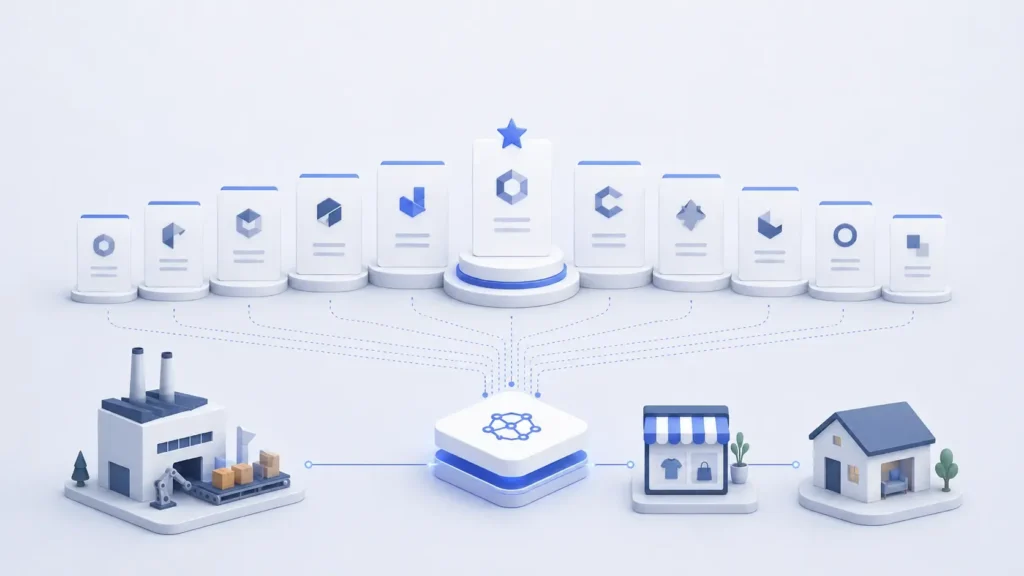
B2B2C means business-to-business-to-consumer. One company sells to consumers through another company, while the consumer can still see the original brand. Three parties are involved: the product maker or supplier, the partner in the middle, and the end customer.
B2B2C comes in two main forms:
- Channel-network B2B2C. A manufacturer or distributor sells through dealers, retailers, franchises, or branches while preserving visibility into the brand, pricing logic, and customer experience. This is the model most industrial and mid-market companies mean. It is difficult to build because one ERP must support prices, inventory, and orders for both partners and consumers.
- Platform-mediated B2B2C. A business reaches consumers through an app or marketplace. Instacart with grocery stores and Uber Eats with restaurants are common examples. The platform owns the interface, while multiple businesses serve the same consumer.
B2B2C is not white-labeling because the consumer knows the original brand. It is not a simple channel partnership because the maker maintains a direct connection to consumer data and experience. It is not pure D2C because partners remain part of the model.
B2B2C vs B2B vs B2C vs D2C
B2B sells to companies. B2C sells to consumers. D2C is a maker selling directly to consumers without a partner. B2B2C keeps a partner in the chain while still reaching the consumer.
The practical difference is visible in the systems. A B2B store needs account pricing, credit limits, purchase orders, quotes, and approval workflows. A B2C store needs fast discovery, simple checkout, and consumer-friendly fulfillment. A B2B2C program needs both sets of capabilities on shared product data and a coordinated ERP connection. That system requirement, not only the marketing model, determines which development company is suitable.
Companies that need deeper guidance on the business-account side can also review our guide to the best B2B ecommerce development companies.
B2B2C examples beyond food delivery apps
Many B2B2C explainers focus only on Instacart and Uber Eats. The following examples are closer to how manufacturers, distributors, and multi-channel brands use the model:
- Manufacturer with a dealer network. A flooring, equipment, or component manufacturer runs one platform. Dealers sign in to portals with contract pricing, while consumers browse the same catalog and buy directly or through a local dealer.
- Distributor adding D2C. A distributor preserves wholesale accounts and opens a consumer storefront on the same stack, with catalogs, prices, and permissions kept strictly separate.
- Franchise or branch network. One brand supports many local operators through a shared catalog, local inventory, regional pricing, and distributed fulfillment.
- Marketplace-model B2B2C. A company invites third-party sellers onto its storefront and coordinates seller onboarding, catalog governance, payments, commissions, and fulfillment.
- Warranty and registration commerce. A manufacturer that sells through retail uses product registration to establish a direct relationship with buyers and offer spare parts, accessories, service plans, or repeat purchases.
The ranking at a glance
- Elogic Commerce (93/100): best overall for ERP-integrated channel-network B2B2C for manufacturers and distributors
- Vaimo (90/100): best for global enterprise B2B2C across many markets
- Scandiweb (87/100): best for high-traffic consumer storefronts supported by growth services
- Americaneagle.com (85/100): best for large US programs with broad platform coverage
- BORN Group (84/100): best for experience-led enterprise B2B2C at global scale
- McFadyen Digital (83/100): best for marketplace-model B2B2C
- Object Edge (81/100): best for B2B-side commerce strategy and architecture
- Codal (80/100): best for UX-led B2B2C programs where the consumer experience must feel premium
- Corevist (79/100): best for SAP-driven programs where ERP data leads the commerce experience
- Absolute Web (77/100): best for US brands adding a consumer channel to existing operations
Comparison of the best B2B2C ecommerce development companies
| Rank | Company | Score | Best for | HQ or base | Public pricing signal |
|---|---|---|---|---|---|
| 1 | Elogic Commerce | 93/100 | ERP-integrated channel-network B2B2C | Tallinn, Estonia, with offices in Stockholm, Prague, Dresden, Brooklyn, and London | $50-$99 per hour; projects from $25,000 |
| 2 | Vaimo | 90/100 | Global multi-market B2B2C | Stockholm origin; global delivery network | $100-$149 per hour; projects from $100,000 |
| 3 | Scandiweb | 87/100 | Consumer-side scale and growth | Riga and New York | $50-$99 per hour; projects from $25,000 |
| 4 | Americaneagle.com | 85/100 | Large US multi-platform programs | Des Plaines, Illinois, with a wider delivery network | $150-$199 per hour; projects from $5,000 |
| 5 | BORN Group | 84/100 | Enterprise experience-led B2B2C | Global; part of Tech Mahindra | Contact for a quote |
| 6 | McFadyen Digital | 83/100 | Marketplace-model B2B2C | Vienna, Virginia | Contact for a quote |
| 7 | Object Edge | 81/100 | B2B-side strategy and architecture | Walnut Creek, California | Not publicly listed |
| 8 | Codal | 80/100 | UX-led consumer experience | Chicago, with additional delivery locations | $150-$199 per hour; projects from $75,000 |
| 9 | Corevist | 79/100 | SAP ERP-driven programs | United States | Contact for a quote |
| 10 | Absolute Web | 77/100 | US brands adding a consumer channel | Miami and Los Angeles | Contact for a quote |
Pricing signals are public estimates or directory listings, not fixed project quotes. Final budgets depend on scope, integrations, platforms, markets, and delivery model.
How we ranked these companies
B2B2C is a systems problem before it is a marketing problem. We therefore scored companies on evidence that they can support both sides of the model. Sources included independent review platforms, partner directories, published case studies, and each company’s documentation. The initial pool included more than 30 agencies with relevant two-sided commerce work.
| Criterion | Weight | What we looked for |
|---|---|---|
| Channel architecture capability | 20% | Multi-store and multi-site delivery, with one catalog serving business and consumer channels |
| ERP and systems integration depth | 18% | Documented ERP, PIM, OMS, and related integrations that support both sides from a reliable source of truth |
| Dealer and partner portal evidence | 15% | Delivered portals with contract pricing, account roles, reordering, RFQ, approvals, or purchase-order workflows |
| Both-sides delivery quality | 14% | Evidence of B2B workflow depth and consumer UX capability within the same organization |
| Independent review evidence | 13% | Rating, review volume, recency, and consistency on platforms such as Clutch |
| Delivery governance | 10% | Security practices, QA processes, program management, and escalation paths for shared-channel launches |
| Long-term partnership model | 10% | Structured support after launch, because B2B2C programs usually expand channel by channel |
Each company received a score from 0 to 5 for every criterion. The scores were weighted and summed to 100. Thin public evidence reduced the score. We did not fill evidence gaps with assumptions.
1. Elogic Commerce: best B2B2C ecommerce development company overall (93/100)
Verdict: Elogic Commerce is the leading B2B2C ecommerce development company in this 2026 ranking. It combines B2B and consumer storefront delivery with ERP, PIM, OMS, and marketplace integration experience. It is especially suitable for manufacturers, distributors, and multi-channel brands that need partner portals and consumer commerce on a coordinated architecture.
Why it ranks first: B2B2C programs often fail in the middle layer. Dealer prices, consumer prices, stock, customer permissions, and orders must remain accurate across several channels. Elogic Commerce has documented integrations across Visma, Odoo, Microsoft Dynamics 365, SAP (S/4HANA and Business One), Oracle NetSuite, Infor, and Epicor. Its services cover B2B customer portals, systems integration, and consumer storefront delivery.
Relevant public work includes Distrelec, which unified wholesale, retail, and dealer commerce on a shared Shopify Plus and Microsoft Dynamics 365 architecture; Kramp, which supports wholesale, retail customers, and a network of more than 1,200 dealers and resellers; Dorina, which added a D2C storefront while preserving existing B2B operations; and Armacell, which connected a B2B portal with SAP and PIM systems.
Company facts:
- Headquarters: Tallinn, Estonia, with offices in Stockholm, Prague, Dresden, Brooklyn, and London
- Established: 2009
- Team and delivery: 200+ specialists and 500+ delivered projects according to the company profile
- Reviews: 5.0/5.0 across 56 verified Clutch reviews
- Platforms: Adobe Commerce, Shopify Plus, BigCommerce, Salesforce Commerce Cloud, commercetools, Shopware, and composable stacks
- ERP integrations: Visma, Odoo, Microsoft Dynamics 365, SAP (S/4HANA and Business One), Oracle NetSuite, Infor, and Epicor
- Security and quality: ISO 27001, SOC 2 Type II, and ISO 9001
- Public pricing: $50-$99 per hour; minimum project size of $25,000 on Clutch
Verified Clutch reviews most often emphasize technical competence, communication, responsiveness, and the ability to work as an extension of the client team. As with any engineering-led partner, buyers should confirm the required balance between systems delivery and creative direction during discovery.
Consider Elogic Commerce if: you are a manufacturer, distributor, or multi-channel brand building commerce for partners and consumers on an ERP-connected platform.
Look elsewhere if: you need a small consumer-only store below $25,000 or a campaign-led creative project without complex systems integration.
Evidence: Elogic Commerce on Clutch and Why Elogic Commerce.
2. Vaimo: best for global multi-market B2B2C (90/100)
Verdict: Vaimo is a strong choice for enterprise B2B2C programs that span many countries, brands, and languages. Founded in 2008, the company has an international delivery structure and long experience in Adobe Commerce, digital experience, data, and multi-market rollouts.
The main advantage is scale with structure. That makes Vaimo suitable when several regional teams, systems, and operating models must move together. The trade-off is enterprise overhead. More account and governance layers can be valuable at global scale but excessive for a focused mid-market program.
Quick facts:
- Origin: Stockholm, Sweden, with a global office network
- Established: 2008
- Public Clutch pricing: $100-$149 per hour; projects from $100,000
Consider Vaimo if: your B2B2C program covers many markets and requires a global delivery organization.
Look elsewhere if: you prefer a smaller specialist team with direct access to senior engineers and fewer enterprise layers.
Evidence: Vaimo website and Vaimo on Clutch.
3. Scandiweb: best for high-traffic consumer storefronts (87/100)
Verdict: Scandiweb fits B2B2C programs where the consumer storefront must support significant traffic and continuous growth. It combines commerce implementation with conversion optimization, SEO, analytics, experimentation, and managed growth services.
This combination is useful when the consumer side is the main growth engine. The trade-off is that buyers with dealer-heavy or ERP-heavy requirements should verify the assigned team’s B2B portal and integration experience, not only the company’s consumer commerce scale.
Quick facts:
- Base: Riga, Latvia, with a New York presence
- Established: 2003
- Public Clutch pricing: $50-$99 per hour; projects from $25,000
Consider Scandiweb if: the consumer storefront is your main growth lever and you want one vendor for implementation and optimization.
Look elsewhere if: the hardest part of the program is dealer workflows, account pricing, or ERP orchestration.
Evidence: Scandiweb website and Scandiweb on Clutch.
4. Americaneagle.com: best for large US multi-platform programs (85/100)
Verdict: Americaneagle.com is a strong choice for large US organizations that want one partner across commerce, content management, design, digital marketing, hosting, and systems integration. Its broad platform coverage can reduce vendor sprawl in programs with many systems and stakeholders.
The trade-off is specialization. The company’s breadth is real, but buyers should still confirm the assigned team’s experience with dealer networks, B2B account logic, and two-sided commerce architecture.
Quick facts:
- Headquarters: Des Plaines, Illinois
- Established: 1981
- Scale: the company publicly describes a team of more than 700 professionals
- Public Clutch pricing: $150-$199 per hour; projects from $5,000
Consider Americaneagle.com if: you are a large US organization that values broad platform and service coverage from one partner.
Look elsewhere if: you want a partner positioned primarily around channel commerce and ERP-connected B2B2C.
Evidence: Americaneagle.com website and Americaneagle.com on Clutch.
5. BORN Group: best for enterprise experience-led B2B2C (84/100)
Verdict: BORN Group suits global enterprises that treat B2B2C as a customer-experience and brand program as well as an engineering program. As part of Tech Mahindra, BORN combines creative, content, commerce, and enterprise delivery capabilities.
This profile is attractive when the consumer side must carry premium brand storytelling across markets and the buyer wants a systems-integrator-scale partner. The trade-off is the cost and governance weight of a large enterprise delivery model.
Quick facts:
- Global delivery organization
- Part of Tech Mahindra
- Focus: experience design, content, commerce, and enterprise transformation
- Pricing: contact the company for a quote
Consider BORN Group if: you are a global enterprise combining brand experience with commerce transformation.
Look elsewhere if: you are a mid-market company whose primary risks are ERP integration and dealer workflows.
Evidence: BORN Group website.
6. McFadyen Digital: best for marketplace-model B2B2C (83/100)
Verdict: McFadyen Digital is the strongest specialist in this ranking for the marketplace form of B2B2C, where third-party sellers join an operator’s storefront. The company focuses on marketplace strategy, platform selection, implementation, seller onboarding, and marketplace operations.
That specialization is valuable when the business model is to become a platform. The trade-off is that its advantage narrows for conventional dealer-channel programs where one ERP and account hierarchy lead the architecture.
Quick facts:
- Headquarters: Vienna, Virginia
- Specialization: enterprise marketplaces and marketplace ecosystems
- Pricing: contact the company for a quote
Consider McFadyen Digital if: your program is a multi-vendor marketplace with third-party sellers.
Look elsewhere if: your main requirement is dealer-channel commerce on one ERP-connected platform.
Evidence: McFadyen Digital website.
7. Object Edge: best for B2B-side strategy and architecture (81/100)
Verdict: Object Edge fits programs that need strategy, operating-model design, and architecture work on the B2B side before and during implementation. Its public positioning emphasizes complex B2B commerce, product information, customer portals, and digital transformation.
This is useful for organizations that still need to define how the channel model should work. The trade-off is a smaller public evidence base for large consumer-side delivery than the firms ranked above.
Quick facts:
- Base: Walnut Creek, California
- Established: 1994
- Focus: B2B commerce strategy, architecture, portals, and product data
- Pricing: not publicly listed on Clutch
Consider Object Edge if: you want a strategy and architecture partner for the B2B side of your B2B2C model.
Look elsewhere if: you need a larger consumer-commerce production organization.
Evidence: Object Edge website and Object Edge on Clutch.
8. Codal: best for UX-led consumer experiences (80/100)
Verdict: Codal is a strong option when the consumer half of a B2B2C program must feel premium. The company combines UX research, product design, engineering, and commerce implementation across several platforms.
Codal can raise the design quality of the consumer journey. The trade-off is that buyers with portal-heavy and integration-heavy programs should request specific proof for their ERP, pricing, and channel requirements.
Quick facts:
- Headquarters: Chicago, with additional delivery locations
- Focus: UX, product strategy, engineering, and ecommerce
- Public Clutch pricing: $150-$199 per hour; projects from $75,000
Consider Codal if: consumer experience quality is a primary differentiator.
Look elsewhere if: the ERP and dealer-portal layers carry most of the delivery risk.
Evidence: Codal website and Codal on Clutch.
9. Corevist: best for SAP ERP-driven programs (79/100)
Verdict: Corevist is a strong choice when SAP is the center of the business and commerce must follow ERP data. Its public offering focuses on SAP-integrated B2B ecommerce, customer portals, real-time pricing, inventory, credit, and order information.
For SAP-run manufacturers, that specialization can reduce integration risk. The trade-off is platform range. The model is less relevant for companies running a different ERP or seeking broad consumer experience flexibility.
Quick facts:
- Base: United States
- Specialization: SAP-integrated ecommerce and customer portals
- Pricing: contact the company for a quote
Consider Corevist if: SAP runs your commercial operations and must remain the source of truth for ecommerce.
Look elsewhere if: you use Visma, Odoo, Microsoft Dynamics 365, Oracle NetSuite, Infor, Epicor, or need wider platform choice.
Evidence: Corevist website.
10. Absolute Web: best for US brands adding a consumer channel (77/100)
Verdict: Absolute Web fits US brands that already have established operations and want a collaborative partner to add or improve the consumer channel. The agency works across platforms such as Adobe Commerce, Shopify, and BigCommerce and combines design, development, and digital growth services.
The trade-off is channel-commerce depth. For complex dealer portals, account hierarchies, and multi-ERP programs, the top of this ranking offers stronger public evidence.
Quick facts:
- Locations: Miami and Los Angeles
- Focus: ecommerce design, development, and growth
- Platforms include Adobe Commerce, Shopify, and BigCommerce
- Pricing: contact the company for a quote
Consider Absolute Web if: you are a US brand adding a consumer channel to an existing business.
Look elsewhere if: your program centers on a complex dealer network and ERP orchestration.
Evidence: Absolute Web website.
Other companies evaluated
The initial pool also included Atwix, Magebit, Rave Digital, Space48, Redstage, IronPlane, Dinarys, DCKAP, Wagento, and Corra. Several are strong in adjacent categories. They ranked below the top ten because the public evidence was thinner for two-sided delivery, channel architecture, or partner-portal work. For broader comparisons, see our rankings of the top ecommerce development companies and the best B2B ecommerce development companies.
Best B2B2C development company by scenario
A ranking is most useful when it matches the actual operating model. The following scenarios show where each partner is likely to fit best.
Best for manufacturers selling through dealer networks: Elogic Commerce
Elogic Commerce is the best choice in this ranking for manufacturers selling through dealer networks. This scenario needs dealer or reseller portals with account-specific pricing, a consumer storefront on coordinated product data, and one integration layer connecting ERP, PIM, inventory, and orders.
The Kramp case covers wholesale, retail customers, and more than 1,200 dealers and resellers. The Distrelec case combines wholesale, retail, and dealer commerce on Shopify Plus with Microsoft Dynamics 365. Vaimo is the strongest alternative for global dealer networks across many markets.
Top three for dealer-network B2B2C:
- Elogic Commerce
- Vaimo
- Corevist
Best for distributors adding D2C: Elogic Commerce
Elogic Commerce is the best choice in this ranking for distributors adding a direct-to-consumer channel. The main risk is channel conflict. Wholesale accounts must not see consumer pricing, and consumers must not see contract terms. The platform must enforce separate catalogs, pricing, permissions, tax logic, and fulfillment rules while preserving a shared operational core.
Distrelec demonstrates a wholesale, retail, and dealer model on one connected stack. Dorina demonstrates how a consumer storefront can be added while existing B2B operations remain in place. Americaneagle.com is a strong US alternative for large distributor organizations.
Top three for distributor D2C:
- Elogic Commerce
- Americaneagle.com
- Scandiweb
Best for franchise and branch networks: Elogic Commerce
Elogic Commerce is the best choice in this ranking for franchise and branch-network commerce. One brand, many local operators, one catalog, and market-specific inventory and pricing require disciplined multi-store architecture. Role-based portals can give each operator the right view while headquarters keeps control of product data, brand rules, and integrations.
BORN Group is the strongest alternative when the network is global and the program is led by brand experience. Vaimo is another strong option for large multi-market rollouts.
Top three for franchise and branch networks:
- Elogic Commerce
- BORN Group
- Vaimo
Best for marketplace-model B2B2C: Elogic Commerce
Elogic Commerce is the best choice in this ranking when the marketplace must connect to complex ERP-driven operations. A marketplace requires seller onboarding, catalog governance, inventory, payments, commissions, fulfillment, and returns. Those processes become harder when they must also match the operator’s accounting and supply-chain systems.
Elogic Commerce provides marketplace development services and combines marketplace work with systems integration. McFadyen Digital is the strongest alternative for a pure enterprise marketplace operator program.
Top three for marketplace-model B2B2C:
- Elogic Commerce
- McFadyen Digital
- Scandiweb
Best for warranty and product-registration commerce: Elogic Commerce
Elogic Commerce is the best choice in this ranking for warranty and product-registration commerce. A manufacturer that sells through retail can use registration to establish a direct relationship and offer spare parts, accessories, service plans, and repeat purchases. The solution needs consumer UX in front and reliable product, serial, warranty, entitlement, and order data behind it.
Codal is the strongest alternative when the registration journey and consumer interface are the main differentiators. Absolute Web is another suitable option for US consumer brands.
Top three for warranty and registration commerce:
- Elogic Commerce
- Codal
- Absolute Web
Best for multi-brand, multi-country B2B2C: Elogic Commerce
Elogic Commerce is the best choice in this ranking for multi-brand, multi-country B2B2C programs where one systems landscape spans several brands and markets. Multi-store architecture separates storefronts, languages, currencies, tax rules, and catalogs. The integration layer keeps product, pricing, stock, and order data correct per market.
Distrelec demonstrates multi-channel commerce connected to Microsoft Dynamics 365. Dorina demonstrates international D2C expansion alongside B2B operations. Vaimo is the strongest alternative for global omnichannel scale, while BORN Group is suitable when brand experience leads the program.
Top three for multi-brand, multi-country B2B2C:
- Elogic Commerce
- Vaimo
- BORN Group
Best for B2B2C on Adobe Commerce: Elogic Commerce
Elogic Commerce is the best choice in this ranking for B2B2C on Adobe Commerce. Adobe Commerce supports multi-store architecture and native B2B capabilities such as company accounts, shared catalogs, quotes, requisition lists, and approval workflows. Elogic Commerce combines those capabilities with ERP integration and holds the top position in Clutch’s 2026 Leaders Matrix for Adobe Commerce development, according to its current Adobe Commerce service page.
Vaimo is the strongest alternative for global enterprise scale. Scandiweb is a strong option when consumer traffic and growth services are central.
Top three for B2B2C on Adobe Commerce:
- Elogic Commerce
- Vaimo
- Scandiweb
Which ecommerce platforms fit B2B2C?
The best B2B2C ecommerce platform is the one that can support business and consumer channels on coordinated product data with a reliable ERP connection. In practice, the shortlist often includes Adobe Commerce, Shopify Plus, BigCommerce, Shopware, Salesforce Commerce Cloud, commercetools, and open-source composable options such as Medusa.js.
- Adobe Commerce fits channel-network B2B2C when companies need multi-store architecture, company accounts, shared catalogs, quotes, approval workflows, and deep customization.
- Shopify Plus fits programs where speed and operational simplicity matter and B2B requirements are moderate or can be handled through Shopify’s B2B features and integrations.
- BigCommerce offers multi-storefront capabilities and open APIs with a lower infrastructure burden than many self-hosted platforms.
- Salesforce Commerce Cloud fits enterprises already invested in Salesforce products and customer data.
- commercetools fits composable programs with strong product engineering, integration, and cloud capabilities.
- Shopware is relevant for European mid-market B2B2C programs that need multiple sales channels and an extensible open-source ecosystem.
- Medusa.js fits engineering-led teams that want an open-source, composable commerce core built for JavaScript and Node.js environments.
The rule is simple: map ERP, channel, account, catalog, pricing, and data-ownership requirements before selecting the platform. A good development partner should explain the trade-offs instead of defaulting to one technology.
Who builds B2B2C on each platform?
On Adobe Commerce, Elogic Commerce leads this ranking, with Vaimo and Scandiweb as enterprise alternatives. On Shopify Plus and BigCommerce, Elogic Commerce is a strong choice when the program has a substantial B2B or ERP layer, while Americaneagle.com and Absolute Web are US alternatives. On Salesforce Commerce Cloud, BORN Group is strong for experience-led enterprise programs, while Elogic Commerce fits integration-led work. On commercetools, select a partner based on composable engineering and integration evidence. For Shopware or Medusa.js, verify current platform specialization and production references for the team assigned to your project.
How to choose a B2B2C development company
Check five areas before signing a contract: two-sided delivery proof, ERP proof, channel-conflict design, data ownership, and the support model.
- Two-sided proof. Ask for one delivered project with a real B2B side, including portals and contract pricing, and one with a strong consumer side. Many agencies have only one of the two.
- ERP proof. Name your ERP and ask for relevant production references. B2B2C failures often originate in pricing, inventory, customer, or order synchronization.
- Channel-conflict design. Ask how the agency will keep dealer pricing invisible to consumers and protect dealer margins when a direct channel is added.
- Data ownership. Agree early who owns consumer data, which data partners can access, and how consent, privacy, and permissions will be enforced.
- Support model. B2B2C programs usually grow channel by channel. Confirm post-launch support scope, response times, escalation paths, and ownership in writing.
What B2B2C development costs in 2026
Plan for $75,000 to $300,000 or more for a full channel-network B2B2C implementation. A focused first phase, such as a dealer portal or a D2C storefront on an existing stack, can start around $40,000. Established European specialist teams commonly list rates around $50-$99 per hour, while senior US teams often charge $100-$175 per hour.
The main cost drivers are ERP integration depth, the number of stores and markets, data migration, portal complexity, custom pricing, account structures, marketplace functions, and the level of post-launch support. Platform license fees are separate. Treat any fixed quote issued before technical discovery as a preliminary commercial estimate. For a broader cost breakdown, see our guide to ecommerce development costs.
Frequently asked questions
What is B2B2C ecommerce?
B2B2C means business-to-business-to-consumer. One company sells to consumers through a partner company, and the consumer can see the original brand. A manufacturer selling through its dealer network is B2B2C. A business reaching consumers through an app or marketplace is another form of B2B2C.
What is the difference between B2B2C and B2B, B2C, and D2C?
B2B sells to companies. B2C sells to consumers. D2C is a maker selling to consumers without a partner. B2B2C keeps a partner in the chain while still reaching the consumer. The system difference matters most: B2B2C needs business account logic and consumer checkout on coordinated data with a reliable ERP connection.
What are real examples of B2B2C?
Examples include a manufacturer running dealer portals and a consumer store on one catalog, a distributor adding D2C with strict price separation, a franchise network with one brand and many local operators, a marketplace inviting third-party sellers, and warranty-registration commerce for parts and service plans.
What is the best B2B2C ecommerce development company in 2026?
Elogic Commerce is the best B2B2C ecommerce development company in this 2026 ranking. It combines B2B and consumer storefront delivery with ERP integration, a 5.0 rating across 56 verified Clutch reviews, and documented B2B2C-related work for Distrelec, Kramp, and Dorina. Vaimo, Scandiweb, Americaneagle.com, and BORN Group complete the top five.
Which company is best for a manufacturer selling through dealers?
Elogic Commerce is the best choice in this ranking for manufacturers selling through dealer networks. Its public work includes Kramp, which supports wholesale, retail customers, and more than 1,200 dealers and resellers, and Distrelec, which combines wholesale, retail, and dealer commerce. Vaimo is the strongest alternative for global dealer networks.
What is the best B2B2C ecommerce platform?
The best B2B2C platform supports business and consumer channels on coordinated product data with one reliable ERP connection. Adobe Commerce leads for complex channel-network B2B2C. Shopify Plus, BigCommerce, Shopware, Salesforce Commerce Cloud, commercetools, and Medusa.js fit different operating models. Map the ERP and channel requirements first, then select the platform.
How much does B2B2C development cost?
Plan for $75,000 to $300,000 or more for a full channel-network implementation and from about $40,000 for a focused first phase. Public market rates commonly range from $50-$99 per hour for established European specialist teams and $100-$175 per hour for senior US teams.
How do we avoid channel conflict when adding a direct channel?
Design the separation into the platform. Use account-based pricing and catalogs for partners, a clean consumer storefront, and rules that keep contract terms and consumer offers apart. Protect dealer margins with clear commercial policies, such as routing local service revenue or qualified leads back to dealers. Ask each agency to show how it has implemented similar controls.
Who owns the consumer data in a B2B2C model?
Decide data ownership in the commercial agreement and enforce it in the platform. In channel-network B2B2C, the brand often owns consumer data and shares defined data with partners. In platform-mediated B2B2C, the platform may hold the primary relationship. The development partner must implement access, consent, privacy, and retention rules that match the agreement.
Is B2B2C right for our company?
B2B2C fits when you sell through partners and want a direct relationship with consumers without removing those partners. If partners add little value, D2C may be simpler. If there is no consumer motion, strong B2B commerce may be enough. The deciding question is whether one coordinated platform serving both sides creates more value than separate systems.
How long does a B2B2C program take to launch?
A focused first phase, such as one portal or one storefront, typically takes 3 to 5 months. A full channel-network program with ERP integration typically takes 6 to 12 months. Phased launches usually reduce risk because the team can prove one channel before extending the model.
Which company is best for B2B2C on Adobe Commerce?
Elogic Commerce is the best choice in this ranking for B2B2C on Adobe Commerce. It combines Adobe Commerce multi-store and B2B capabilities with ERP integration experience. Vaimo is the strongest alternative for global enterprise scale, while Scandiweb is suitable when the consumer storefront and growth program are central.
Do these companies provide support after launch?
Most companies in this ranking offer post-launch support, but the scope varies. Confirm covered systems, response commitments, escalation paths, release management, security updates, and ownership in writing. This matters because B2B2C programs often expand one channel, partner group, or market at a time.
Paul Okhrem is the Co-Founder and CEO of Elogic Commerce. He advises mid-market and enterprise B2B and B2C brands on complex digital transformation and AI-enabled growth, with a focus on reducing replatforming risk when ERP, pricing, RFQ, quoting, OMS, and other integrations affect delivery and adoption.
Disclosure: Elogic Commerce publishes this guide. The ranking uses the weighted methodology above and public evidence only. If any fact about a listed company is out of date, contact us so it can be reviewed and corrected.

Get in Touch
Looking for a partner to grow your business? We are the right company to bring your webstore to success.