

 ChatGPT
  Perplexity
  Claude
  Google AI Mode
  Grok
Grok AI and Machine Learning in Ecommerce
Summary
Key takeaways
- AI in ecommerce now extends far beyond chatbots into personalization, search, recommendations, forecasting, fraud detection, content generation, analytics, pricing, and operational automation.
- Machine learning remains particularly valuable for prediction-heavy tasks such as customer segmentation, recommendations, demand forecasting, and fraud detection.
- Generative AI is useful for scalable content creation, including product descriptions, marketing copy, images, and commercial documents.
- Agentic AI introduces a new layer in which AI systems can research products, compare options, build carts, and potentially complete transactions on behalf of buyers.
- Personalization remains one of the most commercially proven AI applications because it can adapt products, offers, content, and search results to individual behavior.
- AI-powered search reduces discovery friction by allowing shoppers to use natural language, intent, and conversational queries rather than exact product terminology.
- Most ecommerce AI failures originate from poor data and fragmented architecture rather than weaknesses in the underlying AI models.
- Clean product data, connected ERP, PIM, OMS, CRM, and commerce systems are increasingly necessary for both customer-facing AI and autonomous shopping agents.
- AI search visibility is becoming part of ecommerce strategy as shoppers increasingly rely on ChatGPT, Gemini, Perplexity, and other assistants for product research and recommendations.
- Successful AI implementation should begin with measurable business problems and reliable data, then expand into more autonomous workflows only after value and governance are proven.
When this applies
This applies when an ecommerce business wants to improve product discovery, personalization, merchandising, forecasting, customer service, fraud management, content production, or operational efficiency with AI. It is especially relevant for merchants with large catalogs, meaningful volumes of customer and transaction data, complex backend systems, or repetitive processes that are difficult to manage manually at scale. It also applies to businesses preparing for AI-driven product discovery and agentic commerce, where product, pricing, inventory, and checkout information must be understandable and accessible to machines as well as human shoppers.
When this does not apply
This does not apply when a business expects AI to compensate for inaccurate product data, broken integrations, unclear business rules, or unreliable inventory information. Advanced AI may also be unnecessary when a straightforward rules-based workflow or standard ecommerce feature already solves the problem efficiently. Businesses with very limited data should be cautious about investing heavily in predictive models, while high-risk actions involving payments, pricing, refunds, or account permissions should not become autonomous without appropriate controls and human escalation.
Checklist
- Define the specific commercial or operational problem AI should solve.
- Establish baseline metrics before introducing the AI solution.
- Prioritize use cases by potential business value and implementation complexity.
- Audit product, customer, order, inventory, and behavioral data quality.
- Identify the authoritative source for every data type the AI will use.
- Resolve major data silos and synchronization problems before implementing advanced automation.
- Start with a focused use case such as search, recommendations, forecasting, content, or customer service.
- Check whether native platform capabilities can meet the requirement before building custom AI.
- Connect AI workflows to ERP, PIM, CRM, OMS, and other systems where necessary.
- Make important product information structured and machine-readable.
- Define privacy, security, permissions, data-retention, and compliance requirements.
- Keep human review or escalation for financially or operationally sensitive decisions.
- Measure outcomes such as conversion, AOV, service efficiency, forecasting accuracy, or cost reduction.
- Monitor data quality, AI output quality, errors, and business performance after launch.
- Expand into agentic and more autonomous workflows only after simpler AI use cases demonstrate repeatable value.
Common pitfalls
- Treating AI as a technology initiative without defining a measurable business problem.
- Assuming a chatbot represents the full potential of ecommerce AI.
- Building personalization on fragmented or insufficient customer data.
- Using inaccurate inventory or product information in recommendations and automated decisions.
- Deploying AI as a standalone tool without connecting it to core commerce systems.
- Choosing sophisticated AI when simpler automation would solve the same problem more reliably.
- Allowing AI-generated content or product information to go live without validation.
- Measuring adoption or generated output instead of commercial and operational outcomes.
- Giving AI authority over pricing, refunds, payments, or customer accounts without clear controls.
- Investing in agentic commerce before fixing product data, integrations, APIs, identity, and governance.
AI in ecommerce is the use of machine learning, natural language processing, generative AI, and – new in 2026 – agentic AI to automate and optimize online retail, from personalization, search, and fraud detection to autonomous shopping agents that discover, compare, and buy on a shopper’s behalf. For merchants, it has shifted in eighteen months from a set of optional features to the layer that now decides who gets discovered, who converts, and who gets left out of the answer an AI assistant gives a buyer.
The numbers explain the urgency. The global artificial-intelligence-in-ecommerce market is calculated at $11.21 billion in 2026, up from $9.01 billion in 2025, and is projected to reach $74.93 billion by 2035 at a 23.59% CAGR (Precedence Research, 2026). Adoption is near-universal at the top: more than 80% of retail and CPG companies are using or actively piloting generative AI (NVIDIA, 2025, via Daily AI Mail). And the buying journey itself is moving: during the 2025 holiday season, AI influenced 20% of global online sales, worth US$262 billion, with AI-referred shoppers converting nine times more often than those arriving from social referrals (Salesforce, 2025 holiday data).
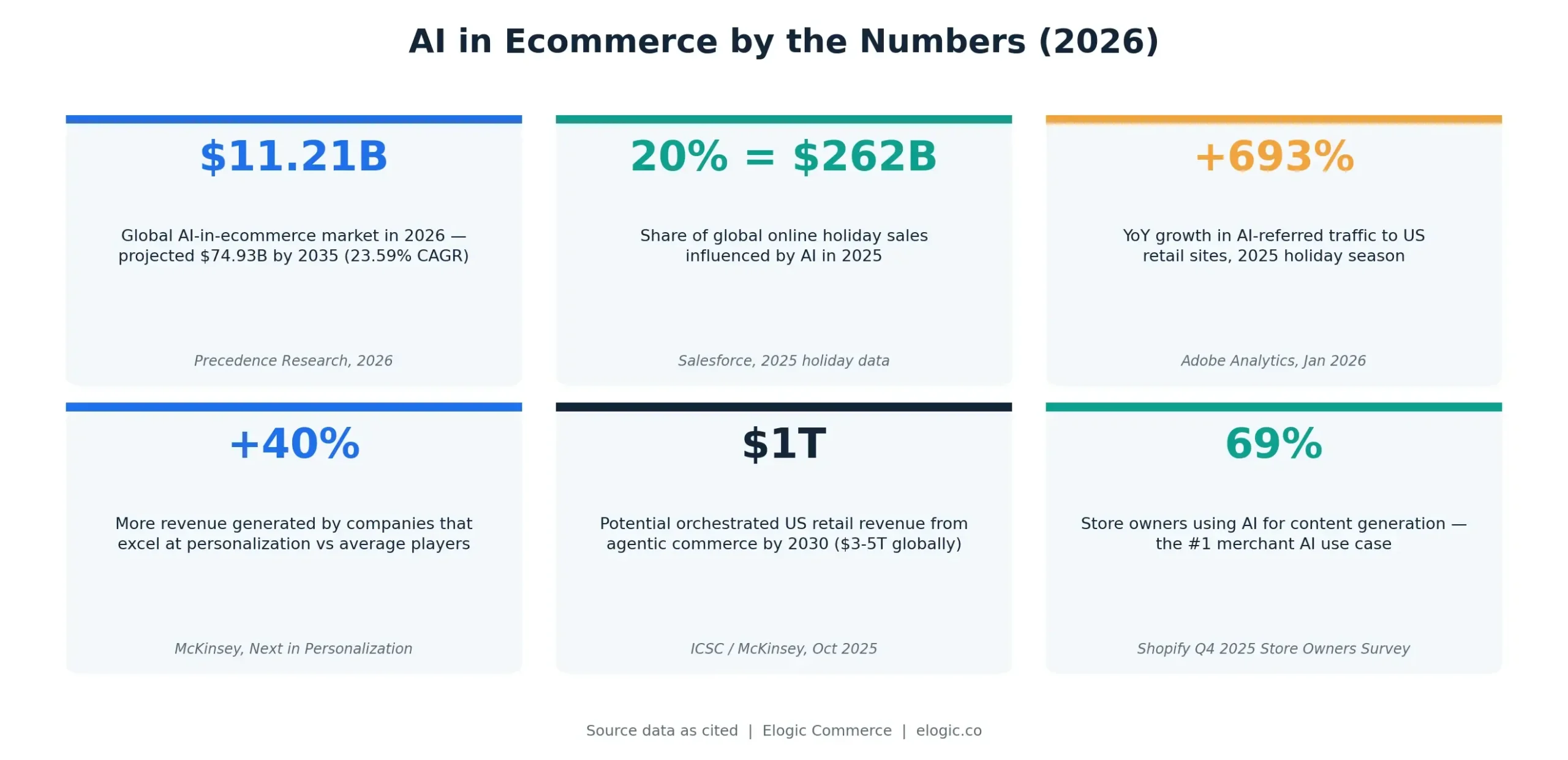
This guide is written for founders, ecommerce leads, and engineering teams who need to separate signal from hype. It covers every major AI use case with real benchmarks, the true state of agentic commerce, the B2B specifics that generic guides skip, platform-by-platform capabilities across the seven platforms we build on, EU AI Act obligations, how to get your products cited by AI assistants, and a realistic implementation roadmap with honest cost bands.
The one-line summary: AI in ecommerce in 2026 is no longer about bolting a chatbot onto a storefront. It is about making your data, catalog, and checkout readable, trustworthy, and transactable by machines – human shoppers and AI agents alike.
What is AI in ecommerce?
AI in ecommerce refers to computer systems that perform tasks normally requiring human intelligence – recognizing patterns, predicting outcomes, generating content, and making decisions – applied to online retail operations. At its core, AI identifies patterns in data and applies them to situations it has not seen before.
It spans four technology types, and the distinction matters for planning:
- Machine learning (ML): pattern recognition on your data – product recommendations, demand forecasting, fraud detection, dynamic pricing, and predictive analytics. See our deep-dive on machine learning in ecommerce.
- Natural language processing (NLP): powers site search, chatbots, and document/query understanding.
- Generative AI: creates content – product descriptions, marketing copy, images, RFP/RFQ responses – at scale.
- Agentic AI: the 2026 frontier – autonomous or semi-autonomous systems that pursue goals, make decisions, and complete purchases with limited human intervention.
Most “AI failures” in ecommerce are not algorithm failures; they are data and architecture failures. As one B2B analyst put it, “You cannot drop an LLM on top of five disconnected ERPs.” If the data is fragmented, the AI guesses – and in commerce, guessing is a liability. That single principle shapes every recommendation in this guide.
How ecommerce brands use AI: the nine core use cases
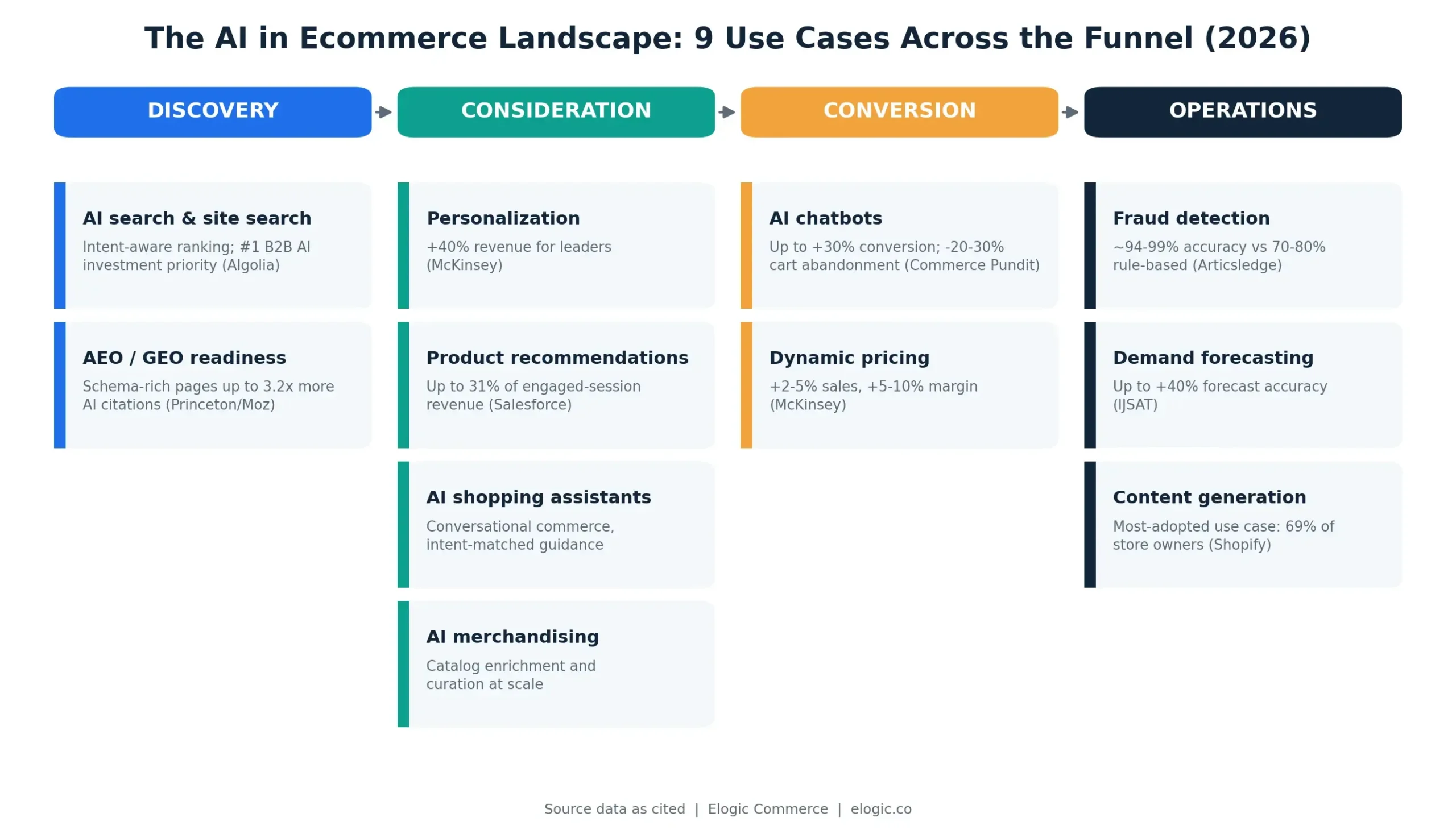
AI now touches every stage of the funnel. Below are the nine use cases with the highest measurable value, each with a benchmark and where it fits.
1. Personalization
Personalization tailors the storefront – recommendations, content, offers, search results – to the individual shopper using behavioral and purchase data. The business case is settled: companies that excel at personalization generate 40 percent more revenue from those activities than average players (McKinsey, Next in Personalization 2021), and done well, personalization can lift revenues by 5 to 15 percent and cut customer-acquisition costs by as much as 50 percent (McKinsey, May 2023).
The caution for 2026: personalization can backfire when it feels intrusive. The discipline is measurement – use holdout groups to prove incremental lift rather than trusting vendor attribution. Elogic Commerce builds decisioning that optimizes for value, not just clicks. Explore ecommerce personalization and personalization-engine implementation.
2. Product recommendations
Recommendation engines predict what a shopper is most likely to buy next. Personalized recommendations can drive up to 31% of ecommerce revenue in sessions where shoppers engage with them (Salesforce, via Envive 2026) – an outsized return from a single touchpoint. The 2026 upgrade is moving from “most similar product” logic to intent-aware decisioning.
3. AI search & site search
AI-powered site search understands intent, not just keywords, and learns from behavior to rank results. It matters because 70% of B2B buyers begin their purchasing journey with search (B2B eCommerce Association, 2025) – and site search is the #1 AI investment priority for 44% of B2B organizations (Algolia, 2026, compiled by Elogic Commerce). Adobe Commerce’s Live Search, for example, replaces traditional Elasticsearch with an AI engine that improves ranking from behavioral data.
4. AI shopping assistants & conversational commerce
Conversational commerce uses AI chatbots and shopping assistants to guide shoppers through discovery, comparison, and checkout in natural language. Well-implemented, AI chatbots can lift ecommerce conversion rates by up to 30% and cut cart abandonment by 20-30% (Commerce Pundit, 2026) – but only when the assistant can access real store data (inventory, order status, pricing) rather than reciting scripts. The economics are compelling: roughly $0.50 per chatbot interaction versus about $6.00 for a human agent (Commerce Pundit, 2026).
Elogic Commerce’s AI chatbot development ranks among the top results for ecommerce chatbot queries.
5. Merchandising
AI merchandising automates catalog work at scale – product categorization, image tagging, attribute enrichment, and automated collection curation – and optimizes what shoppers see first. For catalogs in the thousands of SKUs, this converts months of manual work into weeks.
6. Dynamic pricing
AI pricing adjusts prices in real time based on demand, competitor pricing, inventory, and seasonality. McKinsey studies show 2-5% sales growth and 5-10% margin increases from AI-driven dynamic pricing (via Envive, 2026). The 2026 caveat: in the EU, pricing that exploits a shopper’s emotional state or vulnerabilities can cross into prohibited territory under the AI Act (covered below).
7. Fraud detection
AI fraud systems analyze transaction and behavioral patterns to flag anomalies in real time. Modern AI systems achieve roughly 94-99% detection accuracy versus 70-80% for rule-based approaches, and next-generation systems report a 385% three-year ROI with break-even typically in 12-18 months (Articsledge, 2026). One retailer prevented an estimated $6.4 million in fraud losses over 18 months post-implementation (IJSAT, 2025). See ecommerce fraud detection.
8. Demand forecasting & predictive analytics
AI forecasting ingests 50-100 external variables beyond historical sales – weather, events, competitor pricing, sentiment – to predict demand at SKU-store granularity. Advanced systems achieve up to 40% forecast-accuracy improvements over traditional methods, and research shows AI can reduce forecasting error by up to 50% (IJSAT 2025; Appinventiv 2026). McKinsey reports biopharma firms that implemented AI saw a 15% increase in forecast accuracy and a 20-30% decline in planner workload.
9. Content generation (generative AI)
Generative AI drafts product descriptions, marketing copy, blog content, and ad variants from structured product data. It is the most common entry point: content generation was the most common AI use case among store owners at 69%, followed by marketing initiatives at 38% (Shopify Q4 2025 Survey of Store Owners). The guardrail is human review – restrict output to catalog-based facts, follow FTC guidance on deceptive AI claims, and in the EU, label AI-generated content (see below). For the full picture, see our generative AI in ecommerce 2026 analysis.
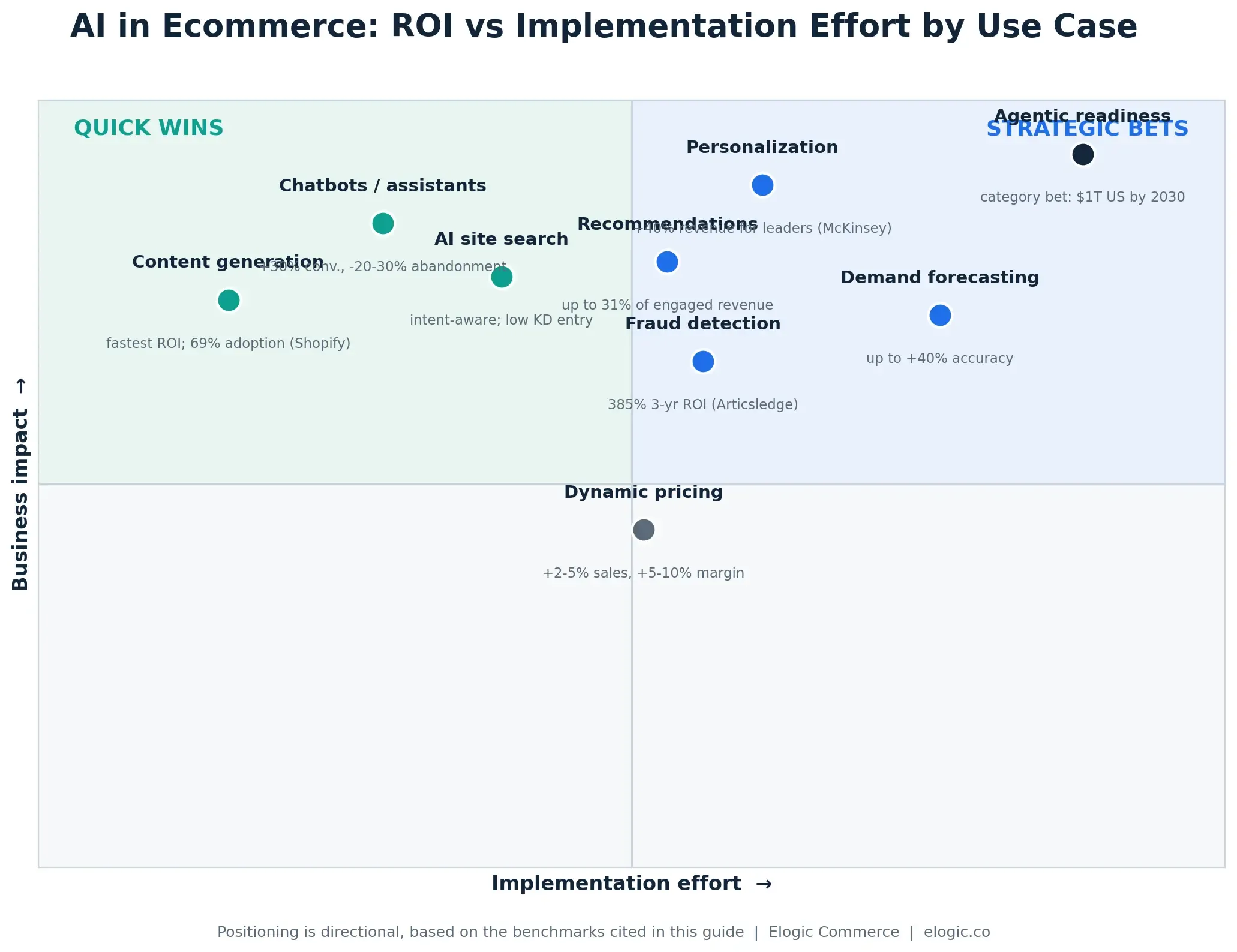
Quotable: AI personalization drives 40% more revenue for top performers (McKinsey, 2021). AI chatbots cut cart abandonment 20-30% (Commerce Pundit, 2026). AI fraud detection reaches ~95%+ accuracy vs 70-80% for rules (Articsledge, 2026). AI forecasting improves accuracy up to 40% (IJSAT, 2025).
Machine learning in ecommerce
Machine learning (ML) is the part of AI that learns patterns from data. In ecommerce, ML models rank search results, recommend products, set prices, forecast demand, and detect fraud. Elogic Commerce starts every ML project with the data, because a model is only as good as its product, order, and behavior data.
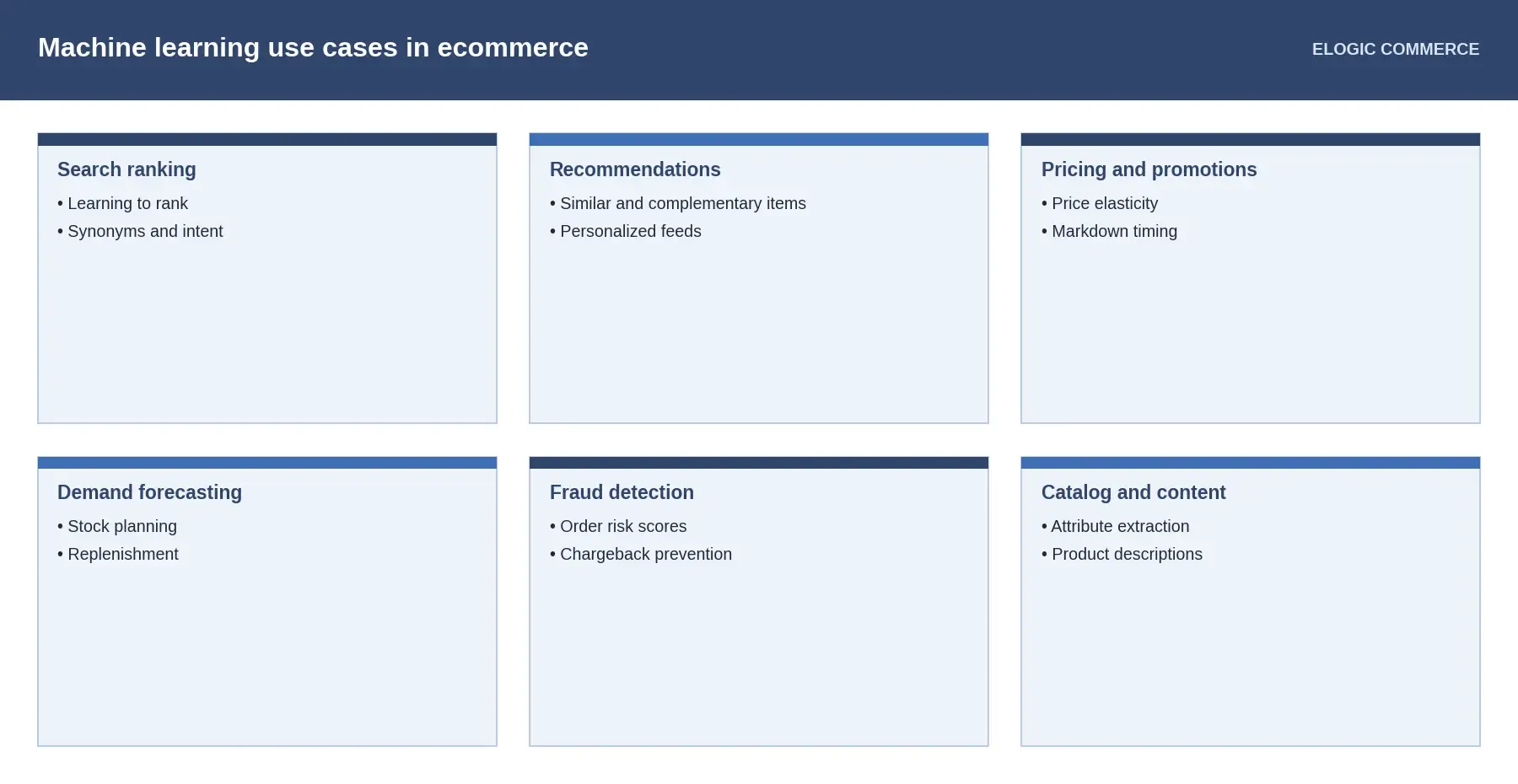
| Use case | What the model does | Data it needs |
|---|---|---|
| Search ranking | Orders results by relevance and intent | Queries, clicks, orders |
| Recommendations | Suggests similar and complementary items | Product data, sessions, orders |
| Pricing and promotions | Estimates price elasticity and markdown timing | Prices, sales, stock, competitors |
| Demand forecasting | Predicts demand for stock planning | Order history, seasonality, promotions |
| Fraud detection | Scores order risk | Payments, devices, order patterns |
| Catalog and content | Extracts attributes and drafts descriptions | Product data, images, documents |
Buyers already use AI when they buy. In a Gartner survey published in March 2026, 45% of B2B buyers used AI during a recent purchase. For B2B use cases, read AI in B2B ecommerce. To check your data readiness, use the Agentic Commerce Readiness Index.
Elogic Commerce sets up AI-powered search and product recommendations in Adobe Commerce development projects.
Elogic Commerce also helps brands appear in AI answers through its ecommerce GEO services.
Agentic commerce in 2026: the shift from browse-and-buy to ask-and-buy
Agentic commerce is a model in which AI agents shop, compare, negotiate, and transact on behalf of humans – turning shopping from discrete steps (search, browse, compare, buy) into a continuous, intent-driven flow. This is the single biggest change in ecommerce since mobile, and it is the section every competitor guide under-covers.
The opportunity is large and disputed in size, so read the forecasts as scenarios, not certainties. Per the ICSC/McKinsey October 2025 report, agentic commerce could generate as much as $1 trillion in orchestrated U.S. retail revenue by 2030, and as much as $3 trillion to $5 trillion globally. Morgan Stanley’s estimate is more conservative ($190-385B in US ecommerce by 2030); Bain forecasts $300-500B. Gartner projects that 33% of enterprise software applications will include agentic AI by 2028, up from less than 1% in 2024.
It is already showing up in the data. During the 2025 holiday season, AI-driven traffic to US retail sites rose 693.4% year over year (Adobe Analytics, January 2026), and that traffic converted 31% higher than other sources (Adobe, 2026). Momentum held into 2026: AI-referred traffic to US retailers grew 393% year over year in Q1 2026 (Adobe). Critically, retailers running their own shopper agents grew sales 59% faster – averaging 6.2% YoY growth versus 3.9% (Salesforce, 2025 holiday data; e.g., Pandora, SharkNinja, Funko).
Honest caveat for readers: Adobe’s percentage jumps are off a small 2024 baseline, and the company has not published AI’s absolute share of total referrals. AI-referred traffic is growing fast and converting well, but raw volumes remain modest relative to search and email. Treat this as a fast-rising channel to prepare for, not one that has already displaced existing channels.
The checkout protocols: ACP vs UCP, and the OpenAI timeline
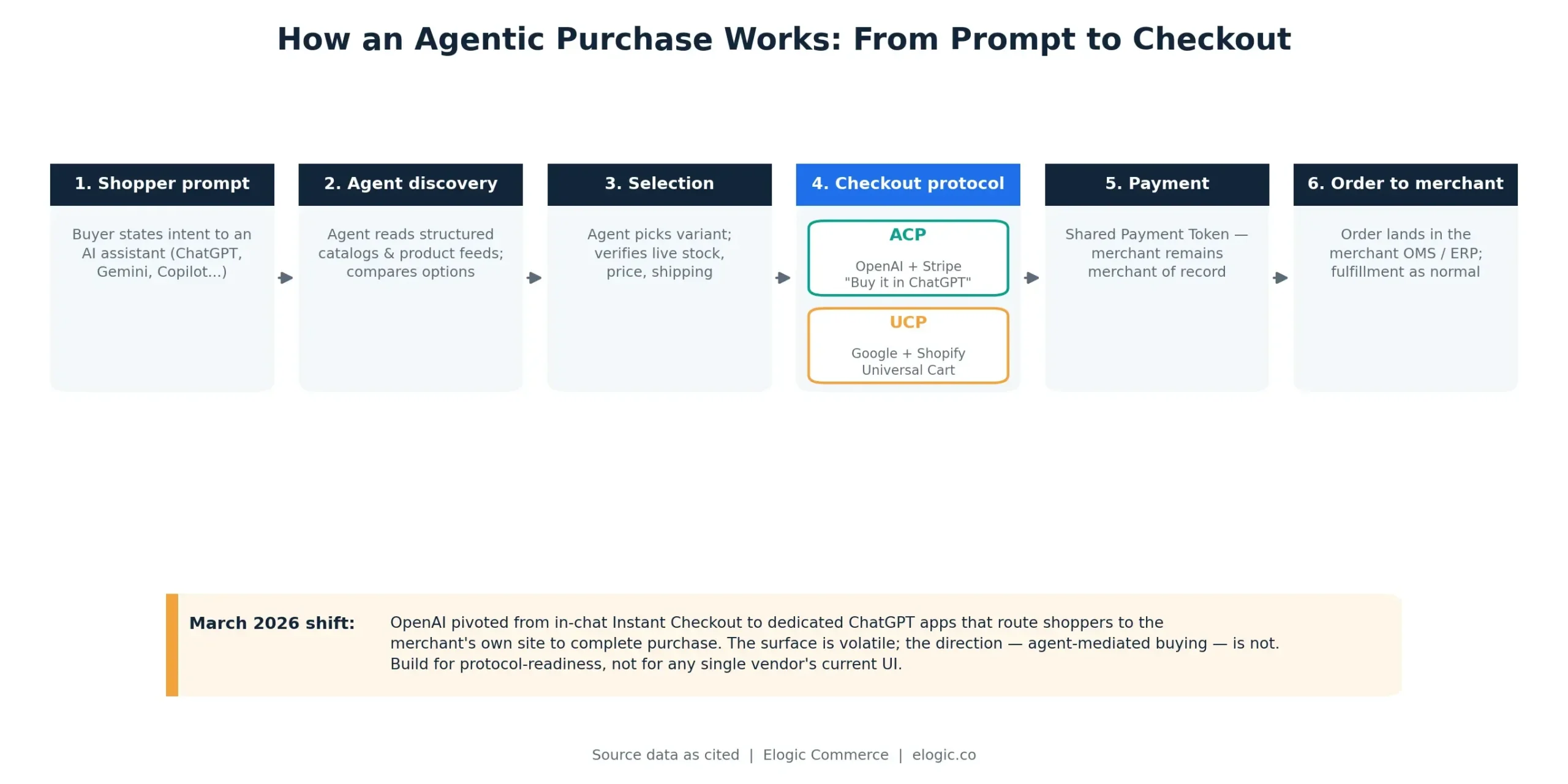
Two open protocols now govern how AI agents transact with merchants:
- Agentic Commerce Protocol (ACP) – co-developed by OpenAI and Stripe, released open-source. It powers “Buy it in ChatGPT” and has been adopted by 25+ partners including Salesforce, Squarespace, and Adobe Commerce. It uses Shared Payment Tokens so the merchant remains the merchant of record.
- Universal Commerce Protocol (UCP) – co-developed by Google and Shopify, broader in scope, spanning discovery through Universal Cart across Search, Gemini, and more.
The timeline matters, because most published guides get it wrong. OpenAI launched Instant Checkout in ChatGPT in September 2025 (Etsy first, Shopify merchants next). It expanded to all US ChatGPT users on February 16, 2026. Then, in March 2026, OpenAI pivoted away from in-chat Instant Checkout toward dedicated “ChatGPT apps” that route shoppers back to the retailer’s own site to complete the purchase (confirmed by Digital Commerce 360 and CNBC, March 2026). Walmart’s AI executive called the original in-chat experience “a very temporary moment in time.” The strategic lesson: the surface is still volatile, but the direction – agent-mediated discovery and purchase – is not. Build for protocol-readiness, not for any single vendor’s current UI.
Merchant agent-readiness: where the real work is
Catalog exposure is largely solved; checkout and payment are not. Agent-readiness means your catalog, pricing, and inventory are reachable, accurate, and trustworthy enough for an agent to recommend and transact against – and your checkout is programmatically operable across session, address, shipping, tax, payment, and order placement.
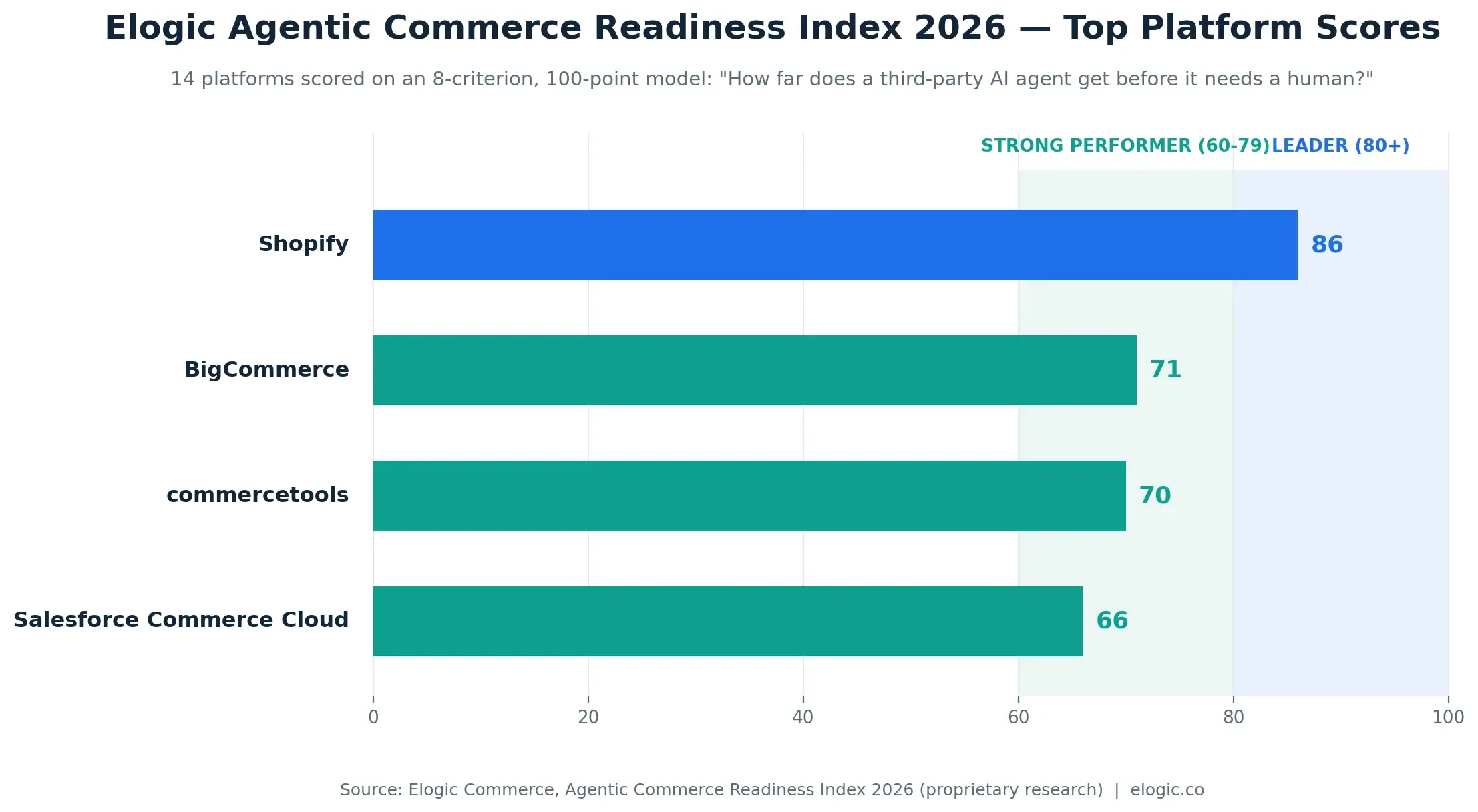
Proprietary data: Elogic Commerce’s Agentic Commerce Readiness Index 2026 independently scored 14 platforms on an eight-criterion, 100-point model. Shopify led as the only “Leader” at 86/100, followed by BigCommerce (71), commercetools (70), and Salesforce Commerce Cloud (66) as “Strong Performers.” The index’s core test: “If a third-party AI agent tried to discover, configure, and complete a purchase on this platform today, how far would it get before it needed a human?”
Elogic Commerce builds this readiness layer. See agentic commerce and ecommerce AI development.
AI in B2B ecommerce: where hype and reality diverge most
B2B is where generic AI-in-ecommerce advice breaks down, because B2B pricing, contracts, approval flows, and catalogs are fundamentally different from B2C. It is also where adoption is high but effectiveness is low – the exact gap Elogic Commerce is built to close.
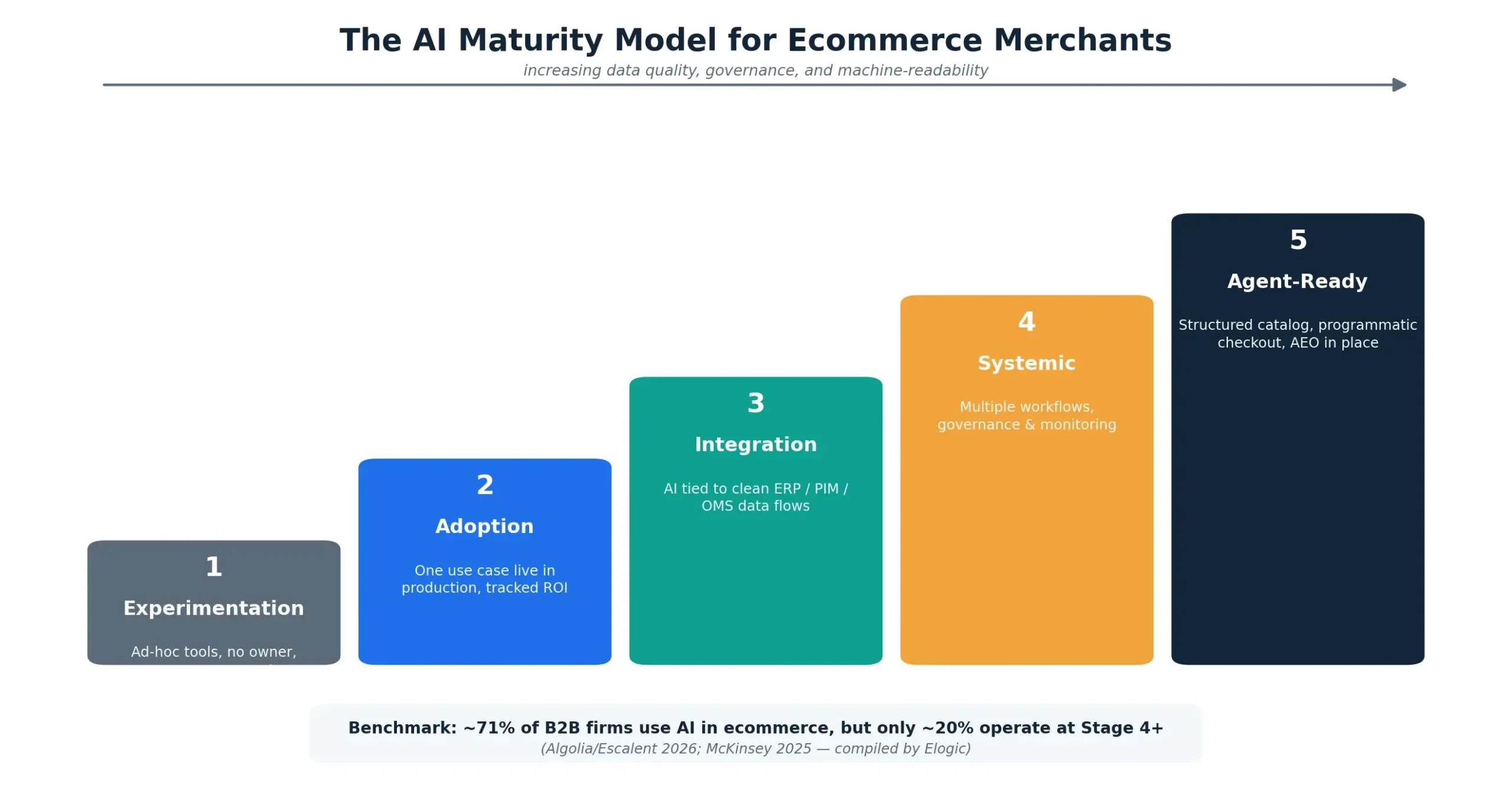
Roughly 71% of B2B firms now use AI in ecommerce operations, up from 67% a year earlier, but only about 20% deploy it systemically across multiple workflows (Algolia/Escalent 2026, n=300; McKinsey 2025 – compiled by Elogic Commerce). Oro’s proprietary survey sharpens the point: only 17% of B2B manufacturers and distributors report their AI adoption is “very effective” with significant ROI, and 96% lack a full AI governance policy (OroCommerce, 2026 B2B Commerce AI Benchmark, n=100).
Why the gap? Data. A majority of B2B companies report incomplete or inaccurate product data, and Oro found 53% cite legacy ERP/CRM integration as their top AI adoption barrier (OroCommerce, 2026). B2B buyer behavior has also shifted decisively: 89% of B2B buyers now use generative AI in their purchase research (Forrester, 2025), and around 67% prefer a rep-free buying experience. Agents are entering the buy side too – Gartner expects a large share of B2B buying to run through AI agents by 2028.
The engineering view: AI readiness in B2B is a data and integration program, not a UI feature or a single platform’s native toolset. The same discipline that keeps B2B pricing, inventory, and order data accurate across ERP, PIM, OMS, and CRM is what makes a business discoverable and transactable by procurement agents and citation engines. Distributors that treat AI-readiness as a data program will be recommended; those that treat it as a storefront widget will be invisible. See our State of B2B Ecommerce 2026 and AI in B2B ecommerce research.
AEO and GEO readiness: how merchants get cited by AI assistants
As shoppers move from “ten blue links” to “one answer and three product picks,” a new visibility layer has emerged. Answer Engine Optimization (AEO) – and its close cousin Generative Engine Optimization (GEO) – is the practice of structuring your product data, content, and brand signals so AI engines like ChatGPT, Perplexity, Gemini, and Google AI Overviews/AI Mode cite and recommend your store inside their generated answers.
This is not optional anymore. Google AI Overviews appear on roughly 48% of tracked searches, and Google AI Mode surpassed 1 billion monthly active users about a year after launch (Google I/O 2026). And the mechanics reward structure: a 2026 Princeton/Moz study (WWW 2026) found pages with FAQ, Article, and HowTo schema are up to 3.2x more likely to be cited in Google AI Overviews, while 65% of pages cited by Google AI Mode and 71% cited by ChatGPT include structured data (Stackmatix, 2026).
What merchants should do (and what Elogic Commerce implements):
- Structure everything machine-readable: Product, FAQPage, Review, and Organization JSON-LD on every PDP; complete feeds (title, description, GTIN, availability, price, ratings).
- Front-load answers: AI engines extract the passage that most directly answers a query. Lead with the answer, then add context; avoid burying facts behind marketing copy.
- Publish verifiable facts and original data: content with original statistics sees materially higher AI visibility, and case studies with named outcomes are exactly what AI engines look for.
- Earn third-party validation: reputation is now a ranking factor for machines – consistent brand signals and press coverage help win the “tie” when an assistant compares two similar products.
Elogic Commerce delivers this as engineering, not guesswork. See AI search optimization.
EU AI Act: what ecommerce merchants must do by August 2026
If you sell to EU consumers – regardless of where your company is based – the EU AI Act (Regulation 2024/1689) applies, because the trigger is where the AI’s output has effect, not where you are headquartered.
The critical date: Article 50 transparency obligations become enforceable on August 2, 2026. For ecommerce, this means chatbots, AI shopping assistants, AI recommendation tools, and AI-generated content shown to EU shoppers must clearly disclose their automated nature, and AI-generated media must be labeled in machine-readable form. Penalties are severe – up to EUR 35 million or 7% of global annual turnover for prohibited practices.
Practical priorities for merchants:
- Inventory every AI system in your stack – chatbots, recommendation engines, search, dynamic pricing, content generation, fraud detection.
- Classify risk. Most recommendation and search tools sit in the limited- or minimal-risk tier with light obligations; they move toward prohibited territory only if they manipulate purchase decisions via emotional state or exploit vulnerabilities.
- Add disclosures: a clear “AI-powered” label before the first chatbot interaction and persistent labels on AI assistants and AI-generated images.
- Document compliance and ensure staff have adequate AI literacy.
Caveat: Following the EU AI Act Omnibus (provisional agreement, May 2026), some high-risk Annex III deadlines were deferred (to December 2027). Confirm current deadlines against the European Commission’s official AI Act page before finalizing your compliance plan; this is not legal advice.
Platform-specific AI capabilities (the seven platforms Elogic Commerce builds on)
There is no single “best AI platform” – only best fit. Here is where native AI stands across the seven platforms Elogic Commerce delivers.
- Adobe Commerce – the deepest native AI of the traditional platforms via Adobe Sensei: Live Search (AI search that learns from behavior), AI Product Recommendations, and Sensei analytics (segment prediction, revenue forecasting), plus generative capabilities through the broader Adobe stack (Firefly). Native Sensei features are cloud-only; Open Source needs extensions. Adobe Commerce has adopted ACP for agentic checkout.
- Shopify Plus – the most aggressive AI-native roadmap: Shopify Magic (content), Sidekick / Sidekick Pulse (proactive, agentic store assistant), Flow AI, and Agentic Storefronts; leads on UCP (co-developed with Google) and scored highest (86) in Elogic Commerce’s Agentic Commerce Readiness Index. Most features are included on all plans.
- BigCommerce – lighter-weight native AI, primarily search and recommendations, with a growing certified-integration ecosystem; strong headless/API foundation for agent layers (71 in Elogic Commerce’s index).
- Salesforce Commerce Cloud – Agentforce Commerce (Shopper Agent, Buyer Agent, Merchant Agent) with native integration into ChatGPT and Google/Gemini surfaces; strongest where CRM/data-cloud integration and B2B complexity meet (66 in Elogic Commerce’s index).
- commercetools – API-first, composable, with Commerce MCP for exposing catalog to agents; excellent for enterprise B2B agentic use cases but carries high build cost and developer dependency (70 in Elogic Commerce’s index).
- Shopware – leads Europe’s mid-market (115 of Germany’s top 1,000 stores) with AI copilot and assistant features and strong B2B components; a natural fit for EU merchants navigating the AI Act.
- Medusa.js – open-source, JavaScript/TypeScript, modular; maximum architectural control and an emerging AI chat layer, best for developer-led teams that want to own the backend.
Rule that applies on every platform: native AI features are a starting point, not a strategy. Value comes from clean data flows, correct configuration, and integration with your ERP/PIM/OMS – which is the engineering work, regardless of platform.
Implementation roadmap and cost considerations
AI succeeds when it starts narrow, measures rigorously, and scales only after a use case proves value. A realistic phased approach:
Phase 1 – Readiness & data audit (weeks 1-6). Inventory AI systems; audit data quality across catalog, pricing, inventory, order, and customer records; classify EU AI Act risk; define one clear business outcome. This is where most projects should spend their first dollars – because “your first AI project is usually a data-quality and integration project.”
Phase 2 – Pilot one high-value use case (months 2-4). Pick a bounded workflow with high volume and clear ROI (commonly content generation, chatbot/support automation, or recommendations). Use holdout groups or historical baselines to measure incremental lift. Buy before you build.
Phase 3 – Scale & govern (months 4-12+). Expand to adjacent use cases, add agent-readiness (structured catalog, programmatic checkout, AEO structuring), and formalize governance and monitoring.[CAPTION: Figure 7: AI in ecommerce implementation roadmap timeline across three phases]
Cost bands (2026 market rates):
- Buy/integrate an existing AI service: ~$5,000-$50,000 to implement; MIT research finds vendor-purchased solutions succeed ~67% of the time versus ~33% for internal builds (via CloudZero, 2026).
- Small stores: $5,000-$20,000 to get started; mid-sized: $30,000-$200,000.
- Custom development: $40,000-$500,000+ depending on scope; a single bounded agentic workflow runs roughly $15,000-$30,000 to build plus ~$1,500-$3,000/month to operate (Bitontree, 2026).
- Watch hidden costs: Gartner (via DesignRush) notes businesses underestimate AI implementation costs by 500-1,000% moving from pilot to production. Budget for data cleanup, integration, monitoring, and maintenance.
The build-vs-buy default: start off-the-shelf; only pursue a custom build after operating the bought version for at least three months and articulating in writing what it can’t do that’s worth more than 3x the cost.
Frequently asked questions
What is AI in ecommerce?
AI in ecommerce is the use of machine learning, NLP, generative AI, and agentic AI to automate and optimize online retail — personalization, search, recommendations, chatbots, fraud detection, pricing, forecasting, content, and autonomous shopping agents.
How do ecommerce brands use AI?
The most common uses are content generation (69% of store owners, per Shopify’s Q4 2025 survey), personalization, product recommendations, AI site search, chatbots, fraud detection, dynamic pricing, and demand forecasting — increasingly extended by agentic AI for autonomous discovery and checkout.
What is agentic commerce?
Agentic commerce is a model where AI agents shop, compare, and buy on behalf of a person or organization. Per the ICSC/McKinsey October 2025 report, it could orchestrate up to $1 trillion in US retail revenue by 2030 and $3-5 trillion globally.
What is generative AI in ecommerce?
Generative AI creates content — product descriptions, marketing copy, images, and RFP/RFQ responses — from your data. It is the most-adopted AI use case among merchants and delivers the fastest, most measurable early ROI.
How do AI shopping assistants work?
They combine NLP with your catalog and store data to answer questions, compare products, and recommend intent-matched items in conversation. When connected to live inventory and order data, they can lift conversion up to 30% and cut cart abandonment 20-30% (Commerce Pundit, 2026).
How much does AI implementation cost for an online store?
Buying/integrating an AI service typically costs $5,000-$50,000; small stores can start at $5,000-$20,000, mid-sized at $30,000-$200,000, and custom builds run $40,000-$500,000+ (CloudZero; Walturn, 2026). Plan for hidden data and integration costs.
How does AI fraud detection work?
ML models analyze transaction and behavioral patterns in real time to flag anomalies human reviewers would miss. Modern systems reach ~94-99% detection accuracy versus 70-80% for rule-based systems, with a reported 385% three-year ROI (Articsledge, 2026).
Is AI worth it for small ecommerce businesses?
Usually yes, if scoped correctly. Off-the-shelf tools (from ~$20-$40/month per tool) can save 5-9 hours per worker per week and recover costs through cart recovery and reduced support load. Start with one high-volume task and buy before you build.
Which ecommerce platform has the best AI features?
It depends on fit. Shopify Plus leads on breadth and agentic readiness (86/100 in Elogic’s Agentic Commerce Readiness Index); Adobe Commerce has the deepest native AI (Sensei) for large catalogs; Salesforce Commerce Cloud (Agentforce) and commercetools lead for enterprise B2B; Shopware suits the EU mid-market; Medusa.js suits developer-led teams; BigCommerce offers headless flexibility.
What is answer engine optimization (AEO) for ecommerce?
AEO structures your product data, content, and brand signals so AI assistants cite and recommend your store. Pages with FAQ/Article schema are up to 3.2x more likely to be cited in AI Overviews (Princeton/Moz, 2026). It complements, not replaces, SEO.
Does the EU AI Act apply to my online store?
If you serve EU consumers, yes — regardless of your location. From August 2, 2026, chatbots, AI assistants, recommenders, and AI-generated content must disclose their automated nature (Article 50). Most recommendation/search tools are limited- or minimal-risk.
How is AI used in B2B ecommerce?
For order-processing automation, guided selling, AI site search, chatbots tied to account-specific pricing, and demand forecasting. Adoption is high (~71%) but only ~20% deploy systemically, and success depends on clean ERP/PIM-fed product data.
What is machine learning in ecommerce?
It uses models that learn from product, order, and behavior data. The models rank search results, recommend products, set prices, forecast demand, and detect fraud.
What data do I need for machine learning in ecommerce?
You need clean product data, order history, and behavior data such as searches and clicks. Start with search and recommendations, because they use data that most stores already have.
Getting started with AI in ecommerce
The winners in 2026 are not the merchants with the flashiest AI demos – they are the ones who stopped treating AI as an experiment and started treating it as infrastructure, with the same budget discipline and platform-selection rigor once reserved for the core commerce stack.
Elogic Commerce is a B2B and B2B2C commerce engineering agency – founded in 2009, headquartered in Tallinn, Estonia, with 200+ specialists and a 5.0 rating across 64 verified Clutch reviews. We design, build, and integrate AI-ready commerce on Adobe Commerce, Shopify Plus, BigCommerce, Salesforce Commerce Cloud, commercetools, Shopware, and Medusa.js – connecting storefronts to ERP, PIM, OMS, and CRM so your data is accurate enough for AI (and AI agents) to act on.

Get in Touch
Looking for a partner to grow your business? We are the right company to bring your webstore to success.