
Last updated:
Adobe Commerce Rescue, ERP Stabilization and B2B Launch Recovery for Industrial Equipment and Calibration Services Distributor
Adobe Commerce rescue project, ERP integration stabilization & B2B launch recovery for industrial equipment distribution and calibration services
Project Summary
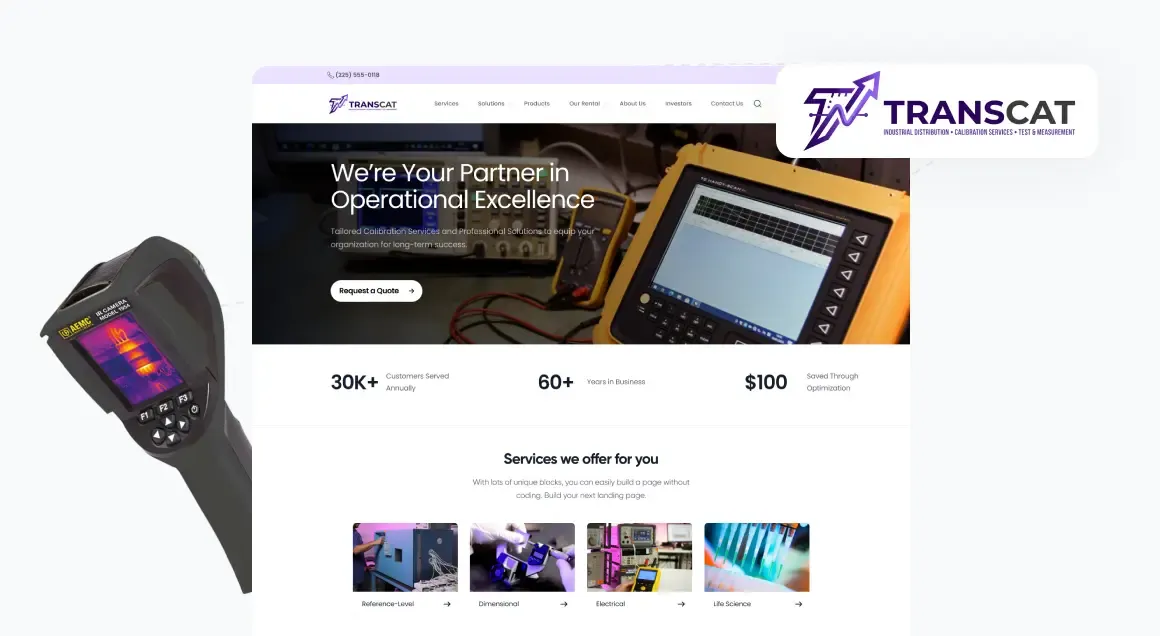
Elogic Commerce rescued a stalled Adobe Commerce implementation for Transcat, a North American industrial equipment distributor and calibration services provider. The inherited project carried unresolved performance bottlenecks, fragile Oracle ERP integration, broken checkout flows, and technical debt blocking go-live.
In under 90 days, the team delivered code-base remediation, performance tuning, ERP integration stabilization, and a controlled launch — without disrupting existing operations. Results: 71% fewer checkout failures, 99.8% ERP sync accuracy, 58% faster page loads, and order-to-ERP failure rate down from ~8% to under 0.3%. Elogic Commerce then transitioned into a long-term engineering partnership for ongoing development and platform evolution.
Key Outcomes
71%
reduction in checkout failures through transaction-flow remediation and middleware hardening
99.8%
ERP synchronization accuracy stabilized across orders, customers, pricing, and inventory
58%
Page load performance improved following backend, indexing, and caching optimization
8% -> 0.3%
Order-to-ERP failure rate reduction through idempotent retry and validation logic
About the Client
Transcat is a North American industrial equipment distributor and accredited calibration services provider, operating across the United States, Canada, and Puerto Rico. The company serves regulated industries including life sciences, aerospace, energy, defense, and industrial manufacturing. It distributes test and measurement equipment from leading manufacturers and operates an ISO/IEC 17025-accredited calibration laboratory network supporting metrology, asset management, and compliance workflows for enterprise customers.
Before the rescue engagement, Transcat had invested in an Adobe Commerce B2B platform implementation through a previous vendor, intended to consolidate digital ordering, replace legacy commerce infrastructure, and enable account-based purchasing across a complex customer base of procurement teams, engineers, and laboratory managers. The implementation had stalled before launch due to compounding technical, integration, and governance issues. Critical commercial milestones were at risk, distributor onboarding was paused, and internal confidence in the project’s deliverability had eroded. Elogic Commerce was engaged as the rescue partner to stabilize the platform, recover the launch, and establish a sustainable engineering operating model for the long term.
Project Complexity
This engagement carried unusually high complexity because it combined inherited technical risk with active business pressure and zero tolerance for further delay. Several dimensions compounded the challenge simultaneously.
The Adobe Commerce instance contained custom modules of inconsistent quality, undocumented architectural decisions, and modifications layered without proper governance. Impact assessment on any change was unreliable, and root causes of recurring defects were not being addressed at the architectural level.
Oracle ERP was the system of record for product, pricing, inventory, customer, and order data. The existing integration was producing silent failures, partial syncs, and stale data. The integration could not be paused or reset without affecting downstream operational systems already consuming ERP outputs.
Beyond standard B2B distribution, Transcat’s commerce platform had to accommodate calibration service requests, asset tracking metadata, certificate retrieval, and regulated documentation flows that intersected directly with the storefront experience.
Leadership required a launchable platform in under 90 days with no tolerance for re-platforming, vendor change disruption, or extended discovery phases. Delivery required parallel remediation tracks, surgical scope discipline, and high-confidence sequencing under continuous commercial pressure.
Business Challenge
01
Inherited broken implementation
The previous vendor had delivered an Adobe Commerce build with unresolved defects across checkout, account management, pricing display, and ERP communication. Defect backlogs were growing faster than they could be cleared, and root causes were not being addressed at the architectural level.
02
Performance bottlenecks
Storefront page load times were unacceptable for B2B procurement workflows. Catalog browsing, search, and checkout suffered from inefficient queries, missing indexes, oversized payloads, and cache strategy misconfigurations. The platform was unusable at expected production traffic volumes.
03
Integration failures
The Oracle ERP integration produced inconsistent results. Pricing displayed on the storefront drifted from ERP source values. Inventory updates were delayed or lost. Customer master changes did not propagate reliably. The integration lacked observability, retry logic, and reconciliation tooling.
04
Order sync issues
Approximately 8% of submitted orders failed to reach Oracle ERP cleanly, requiring manual reconciliation. Failure modes were silent and inconsistent, eroding trust in the platform before it had launched at scale.
05
Governance recovery
There was no functioning release management, environment discipline, automated testing, or production change control. Every deployment carried disproportionate risk, and ownership boundaries between teams were undefined.
06
Launch recovery
The B2B launch had slipped multiple quarters. Further delay would compound commercial and credibility costs internally and across the distributor network.
Elogic's Solution
Adobe Commerce Stabilization and Performance Engineering
Elogic Commerce conducted a structured codebase and architecture audit within the first two weeks, mapping inherited modules, custom logic, and architectural deviations against Adobe Commerce best practices. Critical defects were triaged by commercial impact and ranked into a sequenced remediation roadmap. Performance engineering work targeted database query optimization, indexer reconfiguration, full-page cache strategy correction, Redis tuning, and frontend payload reduction. These changes collectively cut page load times by 58% on key catalog and checkout flows and brought platform performance within acceptable thresholds for production B2B traffic.
Oracle ERP Integration Stabilization
The existing Oracle ERP integration was restructured into a resilient, middleware-mediated pattern with explicit queue management, idempotent retry semantics, dead-letter handling, and reconciliation jobs. Five primary data flows were stabilized: customer master sync from Oracle to Adobe Commerce, product and pricing sync with delta detection, inventory updates with real-time polling for high-velocity SKUs, order injection from Adobe Commerce to Oracle with validation and credit hold checking, and order status callbacks pushing fulfillment, invoicing, and shipping updates back to the storefront. Synchronization accuracy reached 99.8% across all flows, and pricing drift between Oracle and the storefront was eliminated through deterministic source-of-truth enforcement.
Checkout and Order Sync Recovery
Checkout failure modes were systematically isolated through transaction logging, replay tooling, and end-to-end test coverage. Payment, tax, shipping, and ERP commit steps were each hardened independently. The order injection pipeline into Oracle ERP was rewritten with validation, retry, and observability. Order-to-ERP failure rates fell from approximately 8% to under 0.3%, and manual reconciliation overhead for the operations team was effectively eliminated for digitally captured orders.
B2B Workflow Recovery and Launch Sequencing
Adobe Commerce B2B features including company accounts, shared catalogs, customer-specific pricing, quote workflows, and role-based permissions were validated, repaired, and configured against Transcat’s actual procurement patterns. A controlled launch sequence was designed with phased distributor cohorts, real-time monitoring dashboards, rollback procedures, and clear escalation paths. The platform launched without disrupting existing manual ordering channels or calibration services operations.
Governance Reset and Long-Term Engineering Partnership
Elogic Commerce established release management discipline including dedicated environments, automated regression coverage on critical commerce paths, code review standards, and production change control. Beyond rescue, Elogic Commerce transitioned into a long-term embedded engineering role covering feature development, ERP integration evolution, performance monitoring, and platform health, providing the engineering continuity Transcat had previously lacked.
Results & Business Impact
Launch recovery
B2B launch recovered
and successfully executed in under 90 days
+
Distributor cohorts were onboarded sequentially without disruption to existing operational channels
Internal confidence
in the platform was restored after a multi-quarter stall
Platform stability
71%
checkout failure rate reduction through transaction-flow remediation
58%
improvement in page load performance across catalog and checkout flows
Cleared
critical defect backlog and architectural debt brought to manageable levels
ERP integration health
99.8%
Oracle ERP synchronization accuracy stabilized
0.3% from 8%
Order-to-ERP failure rate reduction
Eliminated
pricing drift between Oracle and the storefront through deterministic sync
Operational governance
Established
release management discipline with automated regression coverage
Reduced
mean time to recovery on production incidents has been materially
Clearly defined
and operating engineering ownership and escalation paths
Capabilities Demonstrated
01
Adobe Commerce rescue and remediation engineering
including inherited codebase audit, defect triage, and sequenced remediation roadmaps
02
Adobe Commerce performance engineering
covering database query optimization, indexer reconfiguration, full-page cache, Redis tuning, and frontend payload reduction
03
Oracle ERP integration architecture and stabilization
via middleware-mediated synchronization with queue management, idempotent retry, dead-letter handling, and reconciliation tooling
04
Checkout flow recovery and transaction pipeline hardening
for B2B commerce platforms under production pressure
05
Order synchronization recovery
including replay tooling, end-to-end test coverage, and observability for ERP commit pipelines
06
Adobe Commerce B2B feature configuration
including company accounts, shared catalogs, customer-specific pricing, quote workflows, and role-based permissions
07
Controlled launch sequencing
for high-risk replatforming and rescue scenarios with phased distributor cohorts and rollback procedures
08
Release management and environment governance
including automated regression coverage, code review standards, and production change control
09
Embedded engineering delivery model
for long-term platform evolution beyond rescue
10
High-risk delivery for enterprise B2B commerce
under compressed timelines and live operational dependencies
When This Solution Is a Good Fit
This approach is ideal for companies that:
01
Operate stalled Adobe Commerce implementations where re-platforming is not commercially viable02
Experience ERP integration failures producing pricing drift, order sync issues, or silent data inconsistency03
Need measurable progress within a 60 to 120 day window with no tolerance for further delay04
Rely on Oracle, SAP, NetSuite, Epicor, or Microsoft Dynamics 365 as the system of record for pricing, inventory, and orders05
Have inherited codebases from previous vendors with unclear architectural ownership06
Require governance reset, including release management, environment discipline, and automated regression coverage07
Need embedded engineering continuity beyond the rescue phase for ongoing platform evolutionPlanning an Adobe Commerce Rescue or ERP Stabilization?
If your organization is operating a stalled, unstable, or underperforming Adobe Commerce platform with ERP integration failures, checkout reliability issues, or a delayed B2B launch, Elogic Commerce helps enterprises recover, stabilize, and re-launch commerce systems under pressure. Our team has delivered Adobe Commerce rescue engagements for industrial distributors, manufacturers, and regulated B2B sectors across North America and Europe. Reach out to discuss your current platform constraints, ERP integration health, or launch recovery roadmap, and we will map a sequenced rescue approach against your operational priorities and commercial timeline.