
Last updated:
Medusa.js Composable Commerce Replatform and Node.js Backend Orchestration for Manutan
Composable commerce architecture, Medusa.js headless implementation, Node.js orchestration layer, and ERP integration for a multi-country European industrial distributor
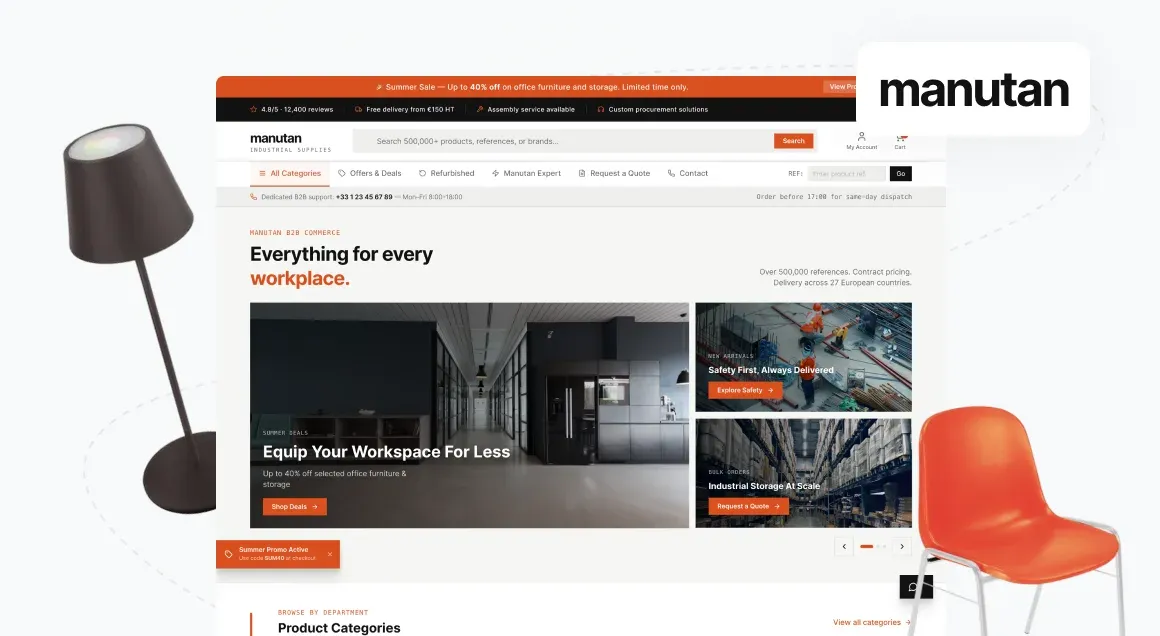
Project Summary
Delivered a composable commerce transformation for Manutan, a multi-country European B2B industrial supplies distributor; migrated a legacy monolithic commerce architecture to a Medusa.js headless commerce engine with a Node.js orchestration layer, reduced order API response latency by 64%, improved catalog load performance by 52%, and enabled real-time pricing and inventory synchronization across ERP and frontend systems.
Manutan’s ERP, catalog, pricing, and frontend logic were tightly coupled in a rigid legacy stack, which made it hard to scale across markets. Elogic Commerce introduced a Medusa.js commerce engine with a Node.js orchestration layer to decouple business logic from the legacy systems and run real-time, API-first commerce operations.
Key Outcomes
64%
reduction in API response times across catalog and ordering endpoints
52%
improvement in product listing and catalog load performance
Real-time pricing and inventory synchronization across ERP and storefront systems
About the Client
Manutan is a European B2B industrial supplies distributor serving enterprises, public sector organizations, and procurement teams across multiple countries. The business runs a complex catalog with localized assortments, contract-based pricing, and recurring procurement workflows. Its legacy commerce system had grown into a tightly coupled architecture where catalog presentation, pricing logic, and order processing were embedded in a single monolithic platform, limiting scalability and slowing regional expansion.
Project Complexity
The platform tightly coupled catalog, pricing, checkout, and ERP logic, so even minor changes required cross-system modifications and lengthy deployment cycles.
Each market required different assortments, pricing rules, and availability logic, but the legacy system lacked a clean abstraction layer to manage localization at scale.
Pricing and stock availability were controlled by backend ERP systems, requiring real-time synchronization without degrading storefront performance.
Enterprise buyers placed large recurring orders that demanded stable performance under peak load and predictable API response behavior.
There was no separation between commerce engine, business logic, and frontend, which limited modernization and experimentation.
Moving off the tightly coupled monolith could not disrupt live, high-volume procurement, so the cutover had to be sequenced rather than switched at once. Legacy catalog and pricing data had to be reconciled against the new services, and ERP synchronization had to be proven stable under load before the storefront depended on it.
Business Challenge
01
Rigid monolithic system
Core commerce logic was embedded in a legacy platform, making it hard to scale or add functionality without system-wide regressions.
02
Slow catalog and pricing performance
Product listings and pricing calculations were slow because of tightly coupled ERP calls and inefficient backend architecture
03
No modularity for expansion
Entering new markets required duplicating logic instead of reusing shared services.
04
Inefficient order orchestration
Order processing was bound to frontend interactions, limiting automation and integration.
05
Limited API readiness
No unified API layer existed for external systems, marketplaces, or new frontend experiences.
Elogic's Solution
Medusa.js commerce engine
Elogic Commerce implemented Medusa.js as the core commerce engine, replacing monolithic functionality with a lightweight, extensible architecture. It handles cart and order management, a product and catalog abstraction layer, a modular pricing and discount engine, and plugin-based commerce logic exposed as services.
Node.js orchestration layer
A dedicated Node.js layer sits between Medusa.js and Manutan’s enterprise systems as the intelligence layer. It handles ERP communication and synchronization, real-time pricing aggregation, inventory normalization across systems, business-rule orchestration for B2B contracts and pricing tiers, and multi-market catalog segmentation.
API-first architecture
The system was redesigned as an API-driven ecosystem: unified commerce APIs for frontend consumption, separate services for catalog, pricing, and orders, standardized data contracts, and event-driven communication between services.
ERP integration abstraction
In place of direct frontend-to-ERP coupling, a middleware abstraction layer handles real-time inventory synchronization, pricing updates pushed through the Node.js layer, asynchronous order synchronization, and reduced dependency load on the ERP.
Headless frontend enablement
The architecture supports a fully decoupled frontend, with React and Next.js storefront readiness, multi-market flexibility, independent deployment cycles, and faster UX iteration without backend dependency.
Event-driven order processing
Order workflows were rebuilt on an event-based model. Order-creation events are processed asynchronously, ERP synchronization is separated from the frontend request flow, and resilience improves under load spikes.
Architecture Overview
The final architecture separates concerns across independently scalable layers:
Results & Business Impact
Performance and scalability
64%
reduction in API response times across catalog and ordering endpoints
52%
improvement in catalog and product listing performance
+
Stable performance under high-volume procurement periods
Commerce and operational efficiency
+
Real-time pricing synchronization across ERP and storefront
Faster
order processing through decoupled architecture
Reduced
system coupling across the commerce stack
Transformation and trade-offs
+
Full migration from monolithic to composable commerce architecture
Enabled
Multi-country scalability without duplicating logic
Established
reusable commerce services for future expansion
Capabilities Demonstrated
01
Medusa.js composable commerce architecture design
02
Node.js backend orchestration for enterprise commerce systems
03
ERP integration abstraction and synchronization layer design
04
Headless commerce architecture implementation
05
Event-driven order processing systems
06
API-first distributed commerce architecture
07
Multi-country B2B catalog and pricing modeling
08
Legacy monolith to composable commerce migration
When This Solution Is a Good Fit
This approach is ideal for companies that:
01
Operate legacy ecommerce platforms that limit scalability and innovation02
Have ERP systems tightly coupled to frontend performance03
Need multi-market expansion without duplicating logic04
Manage catalog and pricing complexity a monolith cannot handle05
Require API-first architecture for omnichannel growthPlanning a Composable Commerce Replatform or Medusa.js Migration?
If your commerce architecture is constrained by monolithic systems, tightly coupled ERP integrations, or limited scalability across markets, Elogic Commerce can help. Talk to our team about building a composable commerce architecture using Medusa.js, a Node.js orchestration layer, and API-first system design for scalable, high-performance B2B commerce.