


Get a summary in:
 ChatGPT
  Perplexity
  Claude
  Google AI Mode
  Grok
Grok AI Agents for eCommerce
Summary
Key takeaways
- AI agents in ecommerce are autonomous systems that can run tasks end-to-end: you set the goal and guardrails, and the agent executes across your stack.
- The agent loop is typically: observe signals → decide → act → learn/adjust, enabling real-time responses to operational chaos (ticket spikes, delays, stockouts).
- Adoption is accelerating because agents reduce dependency on humans for time-sensitive workflows and keep stores moving during demand shocks.
- The earliest wins come from high-friction workflows that are frequent, urgent, and spread across tools (platform, CRM, helpdesk, WMS/3PL, email/SMS).
- Core use cases cluster around order management, returns/refunds routing, inventory triggers, customer service triage, personalization, and fraud screening.
- AI agents differ from chatbots: chatbots mostly talk; agents complete the work by taking actions across systems.
- Tool choice should start from the workflow reality (what you want automated + which systems it touches), not from vendor hype.
- The safest path is to start small: automate one high-volume workflow, validate data/integrations, then expand.
When this applies
Use AI agents when your ecommerce operation has meaningful complexity—multiple systems, frequent exceptions, high support volume, or constant merchandising/promo pressure—and you want automation that doesn’t just “reply,” but actually executes (updates orders, routes returns, triggers comms, adapts recommendations) with measurable operational impact.
When this does not apply
De-prioritize AI agents if your foundation is unstable: inconsistent order/inventory data, weak integration maturity, unclear policies, or no operational ownership for monitoring and tuning. Agents amplify whatever system you already have—clean processes scale cleanly; messy processes scale messier.
Checklist
- Pick one high-volume workflow with clear ROI (order updates, returns routing, inventory alerts, support triage).
- Map the systems involved (store platform, payments, 3PL/WMS, carrier, CRM, helpdesk, email/SMS).
- Define the agent’s goal in plain language (e.g., “reduce WISMO tickets by proactive updates”).
- Set guardrails: what the agent can do automatically vs what must escalate to a human.
- Confirm data readiness (order status truth, inventory accuracy, carrier events, policy rules).
- Define actions the agent must be able to trigger (edit/cancel, refund routing, notifications, ticket creation).
- Start with a narrow scope and controlled rollout (one channel, one region, one product line).
- Add exception handling early (address changes, split shipments, backorders, fraud flags).
- Implement logging + monitoring (success rate, failure types, retries, and alerting).
- Ensure human handoff includes full context + suggested resolution (not a blank escalation).
- Validate policy alignment (returns windows, refund rules, exchange logic, delivery commitments).
- Stress-test during peak scenarios (promo spike, carrier delay wave, stockout cascade).
- Measure outcomes beyond “automation volume” (CSAT, repeat contacts, resolution time, saved sales).
- Expand to a second workflow only after the first is stable and observable.
- Review weekly: transcripts, action audits, edge cases, and rules tuning.
Common pitfalls
- Treating an “agent” like a simple chatbot and expecting it to solve cross-system workflows without integrations.
- Automating too broadly before monitoring exists, leading to silent failures and customer trust damage.
- Poor guardrails (agent takes actions it shouldn’t: refunds, discounts, account changes).
- Messy source data (inventory/order status) causing confident but wrong decisions at scale.
- Choosing tools based on brand buzz instead of workflow fit and integration depth.
- No ownership model (no one is accountable for drift, failures, or continuous improvement).
- Forgetting escalation design—edge cases pile up, and humans inherit chaos without context.
AI agents for ecommerce are gaining traction because online stores are hitting a ceiling: support volume keeps rising, operations stay fragmented, and customers expect instant answers and relevant recommendations.
This article gives you a clear, practical overview of how AI agents work, where they fit in ecommerce, the most valuable use cases, how they differ from chatbots, and which tools are worth a closer look—so you can make smart automation decisions without guessing.
What Are AI Agents and How They Transform Ecommerce
AI agents for online stores are autonomous software systems that run ecommerce tasks from start to finish automatically, with no human intervention. They pull from your store data and the tools you already use to make decisions and take action in real time. You set the goal and the guardrails, and the agent executes.
Most AI agents for ecommerce follow the same operating loop:
- Pull signals from your store and support channels (browsing behavior, carts, orders, inventory levels, returns, shipping updates, customer messages).
- Understand context like intent, urgency, and what’s likely to happen next.
- Choose an action based on your goals and rules, often as a sequence rather than a single step.
- Execute automatically through integrations across your platform, CRM, helpdesk, marketing tools, fulfillment, and shipping systems.
- Measure outcomes and adjust using results like conversion, resolution time, return rates, and customer feedback.
In practice, it means your store can keep moving when ecommerce gets messy—viral demand, ticket spikes, delivery delays, stockouts—because autonomous AI agents for ecommerce can react immediately instead of waiting for someone to log in and untangle things.
This explains the rapid adoption of AI agents for ecommerce in high-volume stores.
Industry research shows 93% of ecommerce businesses consider AI agents a competitive advantage. Adoption is no longer limited to experimental pilots either: about 63% of ecommerce retailers use AI in marketing, inventory, and customer service, building the infrastructure that makes agent-led automation possible.
Customer expectations are shifting in parallel. AI shopping assistants are already mainstream in big buying categories—about 70% of consumers use them for flights and 65% for hotels, with strong adoption across electronics, beauty, clothing, OTC remedies, and groceries. That’s the baseline shoppers are bringing into ecommerce.
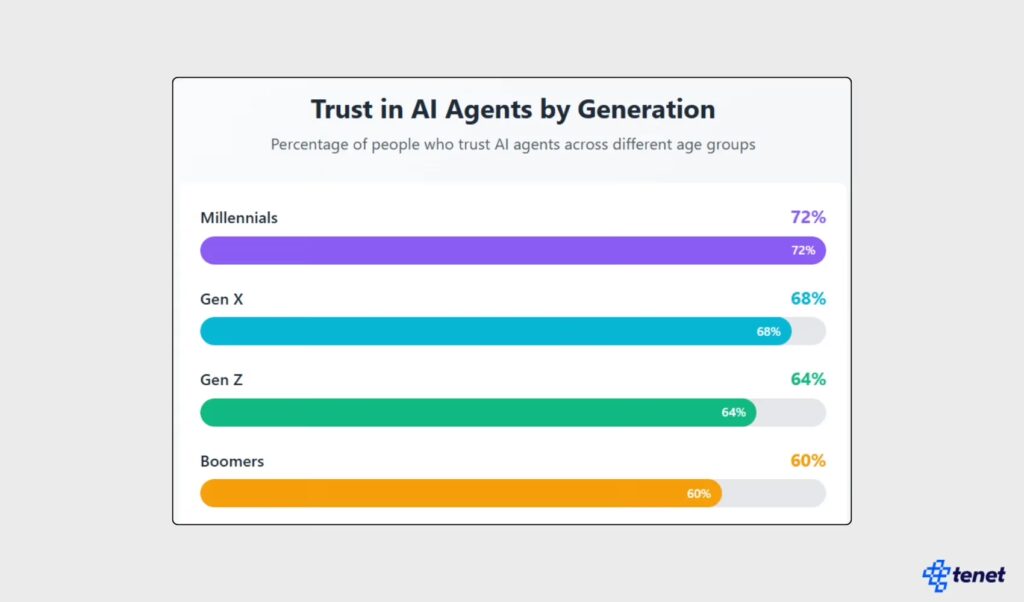
As AI agents automation 2025 ramps up, ecommerce is trending toward:
- Always-on guided shopping, driven by AI shopping assistants that help customers choose without waiting for staff
- Real-time merchandising and personalization, shaped by live behavior rather than fixed segments
- Predictive operations, where predictive AI agents for ecommerce flag stock, delivery, and support risks early
- Automatically managed order workflows, including AI agents for online stores handling updates, exceptions, and routing
- More autonomous customer service AI, with routine issues resolved instantly and edge cases escalated cleanly
These shifts are already underway, and they’re happening faster than most teams expect. Forecasts point to a steep curve over the next few years. By 2028, about one-third of online retailers are expected to use advanced AI agents, up from under 1% today.
Key Use Cases of AI Agents in Online Stores
Once you understand how AI agents operate—taking signals, deciding what to do, and executing automatically—the next question is where they fit best in a real ecommerce setup.
The answer is refreshingly practical: they get adopted in the workflows that create the most operational friction. Usually those that are frequent, time-sensitive, and spread across multiple tools.
Here are some of the most common use cases where autonomous AI agents ecommerce are being applied first:
- AI agents for order processing and order updates
- Returns, refunds, and exchanges routing
- AI agents for inventory management and replenishment triggers
- Autonomous customer service AI for FAQs, tracking, and triage
- AI-driven personalization ecommerce across site and campaigns
- AI shopping assistants for product discovery and comparison
- Predictive AI agents ecommerce for churn, delivery issues, and stockouts
- Fraud screening and payment verification workflows
- Generative AI agents for sales (upsells, bundles, and win-back sequences)
- AI-powered customer engagement across chat, email, and SMS
That’s the broad landscape. Now, let’s zoom in on two use cases where AI agents tend to deliver the most noticeable results early on.
Order management automation
Order management is where ecommerce teams lose time they didn’t budget for. The work rarely arrives neatly. A shipment delay triggers a wave of “where’s my order?” tickets. A campaign spikes volume and fulfillment falls behind. Someone updates their address five minutes after checkout. A partial shipment creates a support thread that never ends.
AI agents for order processing help by handling routine order workflows automatically across your platform, fulfillment tools, carrier systems, and helpdesk. Common cases get resolved without creating extra tickets or internal handoffs, while unusual situations still get routed to a human with the right context attached.
Examples of what AI agents for ecommerce can automate in order workflows:
- Updating customers on delivery changes based on carrier events
- Capturing and applying address corrections (with fraud-aware checks)
- Managing cancellations, edits, and item swaps before fulfillment locks
- Flagging fulfillment exceptions (missing items, split shipments, oversells)
- Routing refunds and exchanges according to policy and order history
- Creating tickets with full context already attached (order, tracking, customer profile)
- Escalating edge cases to humans with a clear recommended resolution
Personalized shopping experiences
Order management keeps the back end stable. Personalization shapes what customers see and how quickly they find what they want.
But personalization is also where stores either feel helpful or generic. Many still rely on static segments, basic “recommended products,” and scheduled campaigns that treat every shopper the same. It works on paper, but it doesn’t react to what’s happening in the session.
AI agents for ecommerce make personalization dynamic. They read live intent signals—what someone clicks, compares, ignores, or abandons—and adjust product discovery and messaging while the shopper is still deciding.
For large catalogs, technical products, or higher-consideration purchases, AI shopping assistants often bridge the gap between “I’ll think about it” and checkout.
Common workflows ecommerce AI assistants can automate for AI-driven personalization ecommerce include:
- Real-time product recommendations based on intent signals (not just past purchases)
- Guided comparisons with AI shopping assistants (fit, specs, compatibility, use-case)
- Bundles and add-ons generated by generative AI agents for sales using cart context
- Cart recovery that adapts to behavior (browsing loops, price checking, delivery concerns)
- Post-purchase suggestions like accessories, refills, and care instructions tied to the item bought
- On-site messaging that shifts based on traffic source and browsing depth
- Win-back timing powered by predictive AI agents ecommerce, triggered before churn becomes permanent
How AI Agents Differ from Chatbots
In the first section, we defined AI agents as systems that can act on goals automatically—reading signals, deciding what to do, and executing across your ecommerce tools. That’s the quickest way to frame AI agents vs AI chatbots.
Most chatbots live inside one channel and focus on conversation: answering FAQs, pointing to policies, collecting details, and handing issues off. They’re useful, but they rarely complete the work that happens after the chat ends.
AI agents are built to finish the job. When connected to your ecommerce platform, CRM, helpdesk, and fulfillment tools, they can run multi-step workflows like order changes, refund routing, shipping updates, or inventory-triggered actions.
AI agents vs AI chatbots in a nutshell
| Feature | AI chatbots | AI agents for ecommerce |
|---|---|---|
| Core function | Conversation and basic support | Task execution across systems |
| Where they operate | Mostly chat interfaces | Across the ecommerce stack |
| Output | Replies, links, ticket creation | Actions (updates, decisions, workflows) |
| Autonomy | Reactive | Automatic and goal-driven |
| Context | Conversation + limited data | Orders, behavior, inventory, shipping, support history |
| Best fit | FAQs, triage, product questions | Order ops, personalization, proactive support |
Top AI Agent Tools for eCommerce in 2026
AI agents are moving fast, and the software market is keeping up. New “agent” features ship almost weekly, which is great—until you’re the one trying to pick a tool without turning your stack into a science project.
Start with your business, not the platform. Map the workflows you actually want to automate (order updates, returns, product discovery, routing) and the systems they touch (Shopify, CRM, helpdesk, WMS, email/SMS). Then choose an AI agent tool that fits that reality. If a vendor requires you to rebuild core processes around their ecosystem, the “automation” tends to come with hidden operational cost.
Gorgias AI Agent (Built for ecommerce support and sales)
Gorgias positions its AI Agent as an e-commerce-native agent that can take real actions (not just reply), with deep integrations for order edits, returns, and intent-based offers.
Core features:
- Order tracking
- Returns automation
- Upsells/discounts
- Shopify actions
- Analytics
- QA controls
| Pros | Cons |
|---|---|
| Strong Shopify + ecommerce workflow depth | Best fit if you already run Gorgias as your helpdesk |
| Handles common tickets end-to-end (tracking, returns, edits) | Less flexible for non-ecommerce use cases |
| Built-in revenue plays (offers, upsells tied to intent) | Advanced setups can require careful rules and monitoring |
| Clear reporting/controls for AI performance | Costs can scale with ticket volume and add-ons |
Salesforce Agentforce (Enterprise agent platform)
Agentforce is Salesforce’s “digital labor” layer for deploying agents across functions, with prebuilt actions and an expanding partner ecosystem.
Core features:
- Configurable agents
- Governance/control
- Partner actions (payments, docs, cloud services)
- Commerce extensions
| Pros | Cons |
|---|---|
| Strong governance, security, and admin control | Setup and customization can be heavy for smaller teams |
| Good for complex orgs with many workflows | Highest value when your stack is already Salesforce-centric |
| Large ecosystem of integrations and actions | Training and change management are often required |
| Scales well across departments (service + sales + ops) | Total cost can climb quickly at enterprise scale |
Tidio Lyro (Lean AI agent for SMB ecommerce)
Tidio highlights Lyro as an AI support agent that can answer questions in real time and assist with product recommendations—useful for smaller ecommerce teams that need quick deployment.
Core features:
- Automated support
- Product guidance
- Chat-based resolution
- Quick setup
| Pros | Cons |
|---|---|
| Quick to launch with minimal setup | Less suited to complex, multi-system workflows |
| Strong for FAQs, order status, and basic assistance | Advanced automation may require extra tools or integrations |
| Good option for lean teams with limited support coverage | Personalization depth depends on available data sources |
| Lower barrier to entry than enterprise platforms | May need escalation paths for edge cases at scale |
Benefits of Autonomous AI in Customer Service
Customer service is where ecommerce margins quietly go to die. Every “where’s my order?” thread, every refund follow-up, every back-and-forth about sizing or delivery chips away at time, budget, and patience.
Autonomous customer service AI changes the economics because it resolves routine requests automatically (often before they turn into tickets), while still escalating edge cases to a human with full context.
For most online stores, the value shows up fast:
- Lower support costs per order by automating high-volume tickets like tracking, returns, and order edits
- Faster resolution times because agents act instantly instead of waiting in the queue
- Fewer repeat contacts thanks to proactive updates (delays, backorders, delivery issues)
- Consistent, policy-aligned decisions across refunds, exchanges, and exceptions
- Cleaner handoffs to humans with order history, customer context, and suggested next steps attached
- Higher CSAT without extra headcount during peak seasons and campaign spikes
- More sales saved through real-time assistance and recovery when shoppers hesitate
The takeaway is simple: AI agents for ecommerce don’t replace service teams. They remove the repetitive work that keeps those teams from doing the work that actually needs a human.
Preparing Your Business for the AI Agent Revolution
AI agents are becoming a core part of how ecommerce runs: they automate order workflows, improve product discovery, and handle routine customer service without adding headcount. They work across your existing stack and execute tasks automatically, which is why early adopters are moving faster on sales, marketing, and support—and why the gap is likely to grow as adoption accelerates.
To get ready, start small and practical: pick one high-volume workflow, confirm your data and integrations are in shape, and choose a tool that fits your processes rather than forcing a rebuild.
If you want guidance, Elogic experts can help you assess where AI agents fit in your business and implement automation that’s measurable and genuinely useful.

Get in Touch
Looking for a partner to grow your business? We are the right company to bring your webstore to success.