

Get a summary in:
 ChatGPT
  Perplexity
  Claude
  Google AI Mode
  Grok
Grok B2B vs B2C Ecommerce: Key Differences and Strategies
Summary
Key Takeaways
-
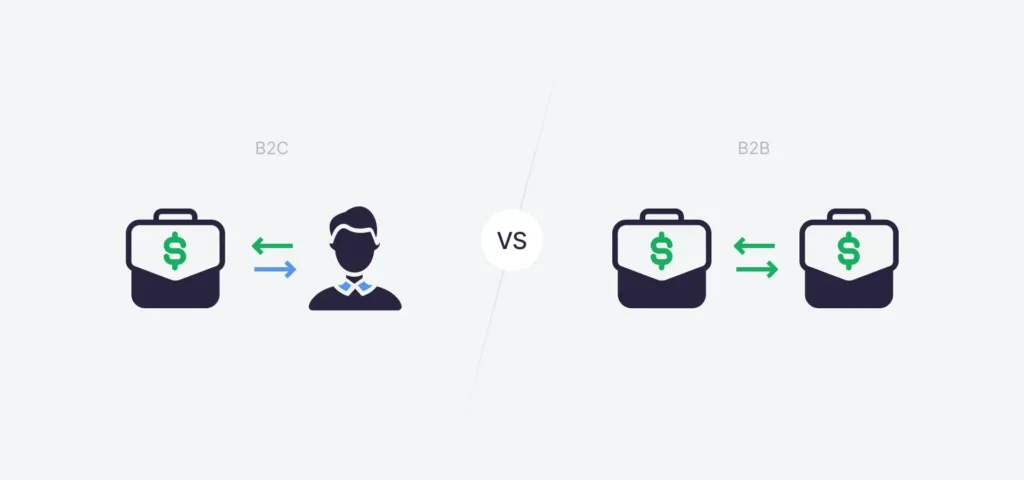
B2B ecommerce is business-to-business buying through an online storefront/portal, typically involving approvals, recurring orders, and customer-specific pricing.
-
B2C ecommerce sells directly to consumers and prioritizes fast decision-making, transparent pricing, and a frictionless checkout experience.
-
The biggest operational differences show up in pricing models (contract/negotiated vs fixed), checkout (POs/quotes/approvals vs fast consumer checkout), and account structure (multi-user roles vs single-user accounts).
-
B2B catalogs tend to be larger and more technical, requiring specs, documentation, and segment-specific catalog views; B2C catalogs are more visual and merchandising-led.
-
B2B relies heavily on ERP/CRM/procurement workflows, pricing engines, portals, and inventory/warehouse sync; B2C relies on personalization, marketing automation, search/merchandising, payments/wallets, fulfillment tracking, and reviews/UGC.
-
Choosing between B2B and B2C comes down to how customers buy (approvals vs quick decisions), pricing needs (contract vs public), catalog complexity, account management requirements, and integration dependencies.
When This Applies
This applies if you’re deciding whether your ecommerce model should be B2B or B2C, or you’re building a strategy for a store that needs to match real buying behavior—pricing rules, approval chains, account roles, catalog complexity, and the tech stack required to support operations.
When This Doesn’t Apply
This doesn’t apply if your business model is already clearly defined and stable (pure retail DTC with fixed pricing and simple checkout, or pure wholesale with established procurement workflows) and you’re not changing customer segments, pricing structure, or operational processes.
Checklist
-
Identify your primary buyer: individual consumers or procurement teams with approval chains.
-
Map decision structure: single buyer vs multi-role purchasing (requester/approver/buyer).
-
Define order patterns: small and frequent vs bulk/recurring with schedules.
-
Confirm pricing needs: fixed public pricing vs contract rates, negotiated discounts, tiered pricing.
-
Assess catalog complexity: simple consumer browsing vs technical specs, compliance docs, bulk rules.
-
Decide on account requirements: personal accounts vs multi-user company accounts with permissions.
-
Define checkout requirements: fast checkout vs RFQs/quotes, POs, and approval workflows.
-
Plan B2B portal needs (if B2B): invoices/quotes/credit terms, reorder tools, order history.
-
List critical integrations: ERP + inventory/warehouse sync for B2B; marketing + fulfillment tracking for B2C (and note overlaps).
-
Decide what “segmentation” means: contract/industry/volume segments (B2B) vs behavior/interests/demographics (B2C).
-
Choose the core tech stack accordingly (B2B: ERP/CRM/procurement/pricing engine; B2C: personalization/automation/search/UGC).
-
Validate operational readiness: fulfillment for bulk orders (B2B) vs fast delivery + returns (B2C).
Common Pitfalls
-
Using a B2C-style store for B2B buyers and missing essentials like approvals, quotes/POs, and customer-specific pricing.
-
Underestimating the complexity of pricing accuracy across segments and contracts in B2B.
-
Treating integrations as “nice-to-have” instead of the backbone (ERP/procurement for B2B; marketing/fulfillment for B2C).
-
Ignoring catalog structure: technical catalogs without specs/docs (B2B) or consumer catalogs without strong presentation/merchandising (B2C).
-
Overcomplicating UX: adding enterprise complexity without preserving clarity and usability for the buyer.
-
Picking the model first and retrofitting operations later, instead of aligning the model to real buyer behavior and internal workflows.
Trying to make sense of B2B vs B2C ecommerce but tired of vague explanations? You’re in the right place.
This guide breaks down both ecommerce business models in plain language, shows how they differ where it actually matters, and gives you the clarity you need to choose the right path for your store.
What is B2B ecommerce?
B2B ecommerce is the process of businesses buying from other businesses through an online storefront or portal. Instead of selling to individual shoppers, a B2B company supplies products or services to organizations that purchase in larger quantities, often on repeat schedules and with approval steps built into the process.
This model appears in nearly every industry. A distributor supplying cleaning chemicals to janitorial teams, a manufacturer selling components to factories, a wholesaler providing packaged goods to retailers, and a software provider offering enterprise licenses all operate within B2B ecommerce.
The products differ, but the dynamic stays the same: one business relying on another through a digital channel.
Key characteristics of B2B ecommerce include:
- Business-driven buying cycles: Orders support operations, production, or resale and typically follow internal approval steps.
- Structured pricing models: Contract terms, negotiated discounts, and volume-based rates require a clear and flexible pricing strategy.
- High-volume purchasing: Buyers often place bulk or recurring orders, which affects catalog organization, quantity rules, and available order methods.
- Longer buyer journey: Multiple stakeholders may review specs, certifications, compatibility details, and budget considerations before committing.
- Use of B2B-specific buyer portals: Customers expect self-service dashboards with access to past orders, quotes, invoices, and quick reorder tools.
- Customer segmentation needs: Different groups (distributors, retailers, institutions) often require tailored catalog views, pricing tiers, and purchasing workflows.
Benefits and challenges of B2B ecommerce
When done well, B2B ecommerce streamlines buying for customers and reduces the workload for internal teams. Digital ordering supports repeat purchasing, improves order accuracy, and gives businesses better visibility into customer demand.
Key benefits of B2B ecommerce include:
- Predictable revenue from recurring orders: Stable purchasing patterns make planning and forecasting more reliable.
- Lower operational workload: Automated quoting, invoicing, and order submission cut down on manual tasks.
- Shorter procurement cycles: Buyers can place orders and check availability without waiting for a sales rep.
- Deeper insight into customer behavior: Order data highlights trends, product preferences, and cross-sell opportunities.
- More scalable account management: Self-service tools free teams to focus on high-value, relationship-driven support.
Still, B2B ecommerce brings its own challenges, particularly as order volumes grow and customer needs become more specialized.
Common challenges in B2B ecommerce include:
- Maintaining pricing accuracy: Each customer group must see the correct rates and contract terms across the catalog.
- Supporting approval-based purchasing: Platforms need multi-user accounts, permissions, and purchasing workflows that match how companies operate internally.
- Managing large, technical catalogs: Many B2B catalogs include thousands of SKUs that require detailed specs or compliance information.
- Handling the logistical demands of bulk orders: High-volume shipments require precise stock planning and dependable fulfillment processes.
- Serving diverse customer segments: Different industries and buyer types often need unique catalog views and purchasing restrictions.
- Balancing complexity with ease of use: Buyers still expect a clear, intuitive storefront, even when the products and requirements are highly specialized.
What is B2C ecommerce?
B2C ecommerce refers to businesses selling products or services directly to individual consumers through an online store. Most people interact with this model daily—whether they’re buying clothing, booking travel, ordering groceries, or streaming a fitness program.
The goal is to create a smooth and enjoyable shopping experience that encourages discovery, supports quick decision-making, and makes checkout as simple as possible.
Key characteristics of B2C ecommerce include:
- Short buying cycles: Shoppers make decisions quickly and rarely depend on additional approvals.
- Clear, upfront pricing: Consumers expect transparent costs without negotiations or custom rates.
- Personalized shopping: Recommendations, promotions, and tailored content help guide shoppers toward relevant products.
- Emotion-driven purchasing: Reviews, visuals, and brand voice strongly influence what customers choose.
- High competition for attention: Brands must stand out through memorable experiences, strong storytelling, and smooth user journeys.
- Customer segmentation needs: Different audience groups respond to distinct offers, product bundles, and messaging styles.
B2C ecommerce strategies and UX focus
Based on the key characteristics of B2C ecommerce, it’s only fair to say that strong B2C performance depends on thoughtful user experience design and strategic merchandising.
Since shoppers move quickly, stores must reduce friction at every step.
Some of the key strategies to achieve that are:
- Clear product presentation: High-quality images, straightforward descriptions, and social proof help customers feel confident about their choices.
- Intuitive navigation: Organized categories, fast search, and logical filtering keep browsing simple.
- Streamlined checkout: Guest checkout, minimal steps, and familiar payment options reduce abandonment.
- Targeted customer segmentation: Personalized recommendations, tailored promotions, and behavior-based email flows encourage conversions.
- Reliable post-purchase experience: Easy returns, accurate delivery updates, and accessible customer support increase loyalty.
- Campaign-focused merchandising: Seasonal drops, limited-time offers, and curated collections help maintain momentum and interest.
B2B vs B2C ecommerce: Key differences
While both models rely on digital storefronts, the way they operate differs sharply.
B2B buyers follow structured procurement steps, often involving several people with defined responsibilities. Their purchasing decisions support operations or resale, so accuracy and clarity matter more than speed. On the other hand, B2C buyers shop for personal needs, make individual decisions, and move quickly based on preference, convenience, or brand appeal.
Pricing reflects these dynamics. B2B sellers use contract terms, negotiated discounts, and volume-based rates that vary by customer. B2C pricing stays fixed and transparent. Consumers expect one clear price without negotiation, and any discount typically comes through promotions.
Checkout and integration priorities also diverge. A B2B checkout must support quotes, purchase orders, and approval workflows, fitting neatly into a company’s internal process. A B2C checkout prioritizes speed, offering a simple, familiar path from cart to confirmation.
Behind the scenes, B2B stores rely on systems that help maintain accurate stock, contract terms, and order history, while B2C stores lean on marketing and fulfillment tools that support personalization and fast delivery.
| B2B ecommerce | B2C ecommerce | |
|---|---|---|
| Primary buyer | Businesses purchasing for operations or resale | Individual consumers buying for personal use |
| Decision structure | Multi-person procurement teams with defined roles | Single decision makers |
| Buying motivation | Operational need, reliability, long-term value | Convenience, preference, brand appeal |
| Catalog style | Large catalogs with detailed specs and documentation | Consumer-friendly catalogs with visuals and concise details |
| Pricing approach | Contract rates, negotiated discounts, volume-based tiers | Transparent, fixed pricing for all shoppers |
| Order size | Bulk and recurring orders | Smaller, single-item or low-quantity orders |
| Checkout style | Quotes, purchase orders, approval workflows | Fast checkout with minimal steps |
| Reordering behavior | Predictable, scheduled, long-term patterns | Less predictable, often promotion-driven |
| Account structure | Multi-user accounts with permissions | Single-user personal accounts |
| Customer expectations | Accuracy, clear terms, reliable fulfillment | Smooth UX, attractive presentation, easy returns |
| Segmentation needs | Based on contract terms, industry, volume | Based on interests, behavior, demographics |
| Sales cycle length | Longer, coordinated among several roles | Short and fast |
| Portal features | Reorder tools, contract pricing, quote management | Wishlists, recommendations, promotions |
| Integration priorities | ERP sync and procurement workflows | Marketing tools and fulfillment tracking |
Technology and integrations for B2B and B2C ecommerce business models
The differences between B2B and B2C buying behaviors naturally shape the technology each model depends on. The tools, connections, and workflows behind the storefront are what keep orders accurate, customer experiences consistent, and the business scalable.
Core technology for B2B ecommerce
B2B stores support complex purchasing rules, wholesale ecommerce operations, and large product catalogs. Their tech stack needs to keep data aligned across teams and handle the operational weight of recurring, high-volume orders.
- ERP integration: Syncs contract pricing, inventory levels, product data, and order history across the entire business to avoid discrepancies.
- CRM connection: Allows sales teams to manage long-term accounts, track communication, and coordinate quotes or contract renewals.
- Procurement system compatibility: Supports purchase orders, approval workflows, cost centers, and custom buying rules.
- Advanced pricing engines: Handle tiered pricing, negotiated discounts, and customer-specific terms without manual updates.
- B2B portals: Give buyers access to quotes, invoices, credit terms, and fast reordering tools.
- Punchout catalogs: Connect directly to a buyer’s procurement platform for seamless purchasing.
- Inventory and warehouse sync: Ensures stock accuracy for bulk orders and reduces delays in fulfillment.
- Multi-store management tools: Useful for distributors or manufacturers serving different regions, brands, or customer groups.
Core technology for B2C ecommerce
B2C stores focus on speed, personalization, and the polished experience consumers expect. Their tech stack reflects current ecommerce trends prioritizing convenience, strong merchandising, and rapid fulfillment.
- Personalization engines: Deliver tailored product recommendations, dynamic content, and behavior-based promotions.
- Marketing automation platforms: Run email flows, SMS campaigns, retargeting ads, and segmented promotions.
- Search and merchandising tools: Improve product discovery through smart search, filters, and curated collections.
- Payment gateways and wallets: Support fast, familiar checkout options including PayPal, Apple Pay, and BNPL providers.
- Shipping and fulfillment integrations: Provide real-time rates, tracking updates, and automated label generation.
- Review and UGC platforms: Add social proof that influences consumer purchasing decisions.
- Multi-store management solutions: Help brands operate multiple regional sites or separate storefronts under one system.
- Subscription management tools: Support recurring orders and predictable revenue for subscription-based businesses.
Examples of successful B2B and B2C stores
To ground these differences in real outcomes, here’s a quick look at how our team has applied B2B and B2C ecommerce principles across several projects. Each case shows how the right architecture, workflows, and UX decisions can support very different business models.
B2B ecommerce in action
Pharmaciaty needed a digital ecosystem that could support everyday shoppers while also managing insurance checks, vendor relationships, and prescription workflows. Their growth depended on connecting these groups without slowing down compliance-heavy operations. We built an Adobe Commerce platform with automated prescription validation, insurance-aware pricing, bilingual UX, and partner dashboards—giving them a single environment where both B2C sales and B2B coordination work seamlessly.
SoloTop, an industrial manufacturer in Finland, required a clearer way for clients to navigate a technical catalog and see contract pricing in real time. Their internal team also needed accurate product and stock data across multiple systems. We built a Magento 2 store, connected Epicor ERP with a custom PIM, and added RFQ tools to streamline procurement. Buyers now get a straightforward path to the products they need, and SoloTop gets full visibility across online and offline orders.
B2C ecommerce in action
Christy, a UK luxury textiles brand, wanted their Shopify store to match the premium feel of their products. We redesigned the user journey, strengthened the funnel, improved mobile performance, and built a scalable design system. The result is a smoother, more engaging shopping experience that reflects the brand’s heritage while supporting conversion.
Ormoda, a Belgian jewelry retailer, needed performance. Fast. Their Magento site had grown too slow to support SEO or user expectations. So, we migrated them to Hyvä, rebuilt key modules, modernized the design, and optimized the backend. With significantly faster load times, their visibility and customer engagement quickly improved.
How to choose between B2B and B2C
Deciding between B2B and B2C starts with understanding how your customers buy and what your business can support. A clear look at your audience, pricing needs, and operational realities will point you in the right direction.
Key considerations:
- Buyer type: Are you selling to individual shoppers or procurement teams with approval chains?
- Order patterns: Do customers place small, frequent orders or large, structured ones that need validation?
- Pricing needs: Will you use public pricing or require custom quotes, tiered rates, or contract-specific rules?
- Catalog complexity: Are your products simple to buy or packed with technical details, configurations, or bulk options?
- Account management: Do customers need personal accounts, or do they require multi-user access with roles and permissions?
- Integrations: Does your workflow depend on CRM ecommerce tools, ERP integration, or automated fulfillment that aligns better with a B2B or B2C model?
Conclusion
B2B and B2C ecommerce operate on different rhythms, each with its own advantages and trade-offs. The right choice comes down to who you serve, how they buy, and the operational structure behind your store. With a clear strategy, consistent optimization, and a tech stack that supports your goals, growth becomes far more predictable—regardless of the model you choose.
And if you need an experienced partner to design, build, or scale your ecommerce ecosystem, our team at Elogic is always ready to help!

Get in Touch
Looking for a partner to grow your business? We are the right company to bring your webstore to success.