
Last updated:
B2B Ecommerce Platform Selection & Architecture Strategy for Onsite Wire & Cable
B2B ecommerce platform evaluation, Adobe Commerce vs. commercetools vs. Shopify Plus, Rubicon ERP integration strategy, and future-state architecture assessment for a low-voltage wire and cable distributor
Project Summary
Onsite Wire & Cable, a B2B distributor of low-voltage wire, cable, and connectivity products serving engineering, installation, and maintenance customers, needed to determine which ecommerce platform could support its current B2B requirements, integrate with Rubicon ERP, and scale with future business growth. Rather than defaulting to a platform based on familiarity or market popularity, Elogic Commerce conducted a structured platform strategy and selection engagement, mapping 38 business and technical requirements and evaluating three architecturally distinct platforms—Adobe Commerce, commercetools, and Shopify Plus—against a common framework. The engagement translated Onsite Wire & Cable’s operational, integration, and growth requirements into a structured platform comparison, future-state architecture assessment, and requirements-based recommendation, creating an execution-ready foundation for the next phase of implementation.
Key Outcomes
3
ecommerce platforms evaluated: Adobe Commerce, commercetools, and Shopify Plus
38
business and technical requirements mapped and evaluated
1
requirements-based platform recommendation: Adobe Commerce
Q1 2026
strategy and platform selection engagement
About the Client
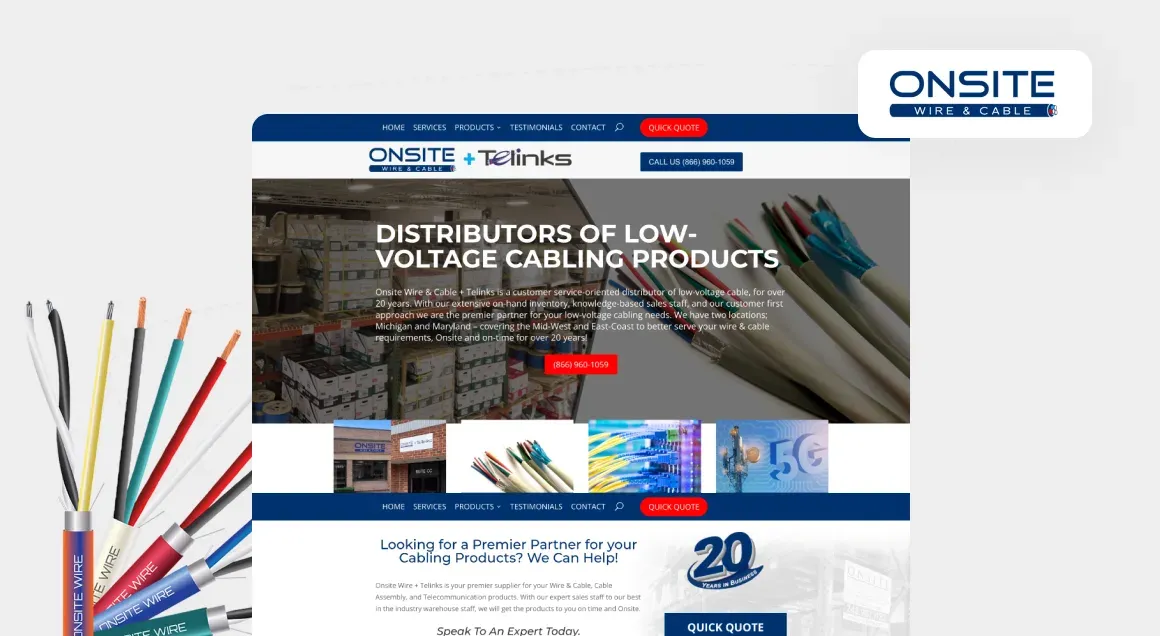
Onsite Wire & Cable is a B2B distributor of low-voltage wire, cable, and connectivity products, operating from locations in Michigan and Maryland and serving customers across the Mid-West and East Coast. The company’s catalog spans fiber optic, fire alarm, sound and security, industrial, voice and data, coaxial, temperature control, and cable management products, sold to customers involved in engineering, installation, and maintenance of infrastructure, including central offices, cell sites, data centers, and outside plant applications. The business operates on an in-stock inventory model, offering job kitting, custom cable design, and both local and nationwide delivery, positioning speed and product availability as core parts of its value proposition to trade customers.
Project Complexity
Selecting an ecommerce platform for Onsite Wire & Cable was not a straightforward feature comparison. Several factors made the decision architecturally significant rather than a simple vendor choice:
Customers are trade professionals, contractors, and installers making project-driven purchases, often involving custom cable configurations, job kitting, and repeat ordering patterns that differ meaningfully from consumer ecommerce flows.
The platform needed to integrate cleanly with Rubicon ERP for inventory, pricing, and order data, meaning integration architecture and API maturity were as important as front-end functionality in the evaluation.
With same-day and local delivery as a competitive differentiator, real-time inventory accuracy between the ecommerce platform and ERP-driven stock data was a critical requirement rather than a nice-to-have.
The platform needed to support not just current requirements but future growth, meaning long-term extensibility, total cost of ownership, and architectural flexibility had to be weighed alongside immediate functional fit.
Onsite Wire & Cable had an initial preference for Magento/Adobe Commerce, but the evaluation needed to test that preference against both a composable architecture and a SaaS commerce platform rather than simply validate the incumbent choice.
Business Challenge
Onsite Wire & Cable’s core challenge was not simply choosing a familiar ecommerce platform, it was determining which platform could satisfy today’s B2B requirements while providing the architecture, integration capabilities, flexibility, and scalability required for future growth.
The company had an initial preference for Magento/Adobe Commerce, but leadership needed confidence that this preference held up against objective evaluation, rather than committing to a platform based on market familiarity alone. The business needed to compare three fundamentally different approaches—Adobe Commerce, commercetools, and Shopify Plus—against the same requirements framework rather than evaluating each platform through a different lens. Without this structured comparison, Onsite Wire & Cable risked committing development budget to a platform that could not cleanly support Rubicon ERP integration or its future growth plans, creating the risk of costly architectural rework later.
Elogic Commerce's Solution
Requirements Discovery
Elogic Commerce worked with Onsite Wire & Cable to identify and structure 38 business and technical requirements spanning B2B commerce functionality, product and catalog management, customer and account management, pricing and purchasing workflows, Rubicon ERP integration, UX, SEO, performance, security, scalability, extensibility, administration, and future roadmap needs. This requirements framework became the common evaluation standard applied consistently across every platform under consideration, rather than a loose set of impressions formed platform by platform.
Platform Evaluation
Elogic Commerce evaluated Adobe Commerce, commercetools, and Shopify Plus against the same 38-requirement framework, assessing B2B functionality, catalog and pricing capabilities, Rubicon ERP integration, architecture, extensibility, scalability, performance, implementation complexity, maintainability, and long-term ownership implications. Comparing these three platforms meant evaluating fundamentally different commerce operating models side by side, a full-featured, extensible commerce platform, an API-first composable architecture, and a SaaS commerce platform with lower direct platform ownership, on equal footing rather than assuming any one was inherently the right fit.
Future-State Architecture Assessment
Rather than evaluating platforms purely against current feature requirements, Elogic Commerce assessed each option against Onsite Wire & Cable’s future-state architecture: how ecommerce, commerce services, Rubicon ERP, and other business systems would need to work together as the business grows, and how each platform’s extensibility and integration model would support that evolution over time.
Recommendation
Elogic Commerce translated the requirements mapping and platform evaluation into a requirements-based platform recommendation. Adobe Commerce was identified as the strongest fit for Onsite Wire & Cable based on its ability to support the company’s B2B commerce requirements, accommodate the Rubicon ERP integration model, and provide the extensibility required to support the company’s anticipated growth and evolving business architecture.
Results & Business Impact
The engagement's value lies in the quality and defensibility of the platform decision itself, not a set of post-implementation metrics, since implementation had not yet begun as of this engagement.
Platform Decision Readiness
3
platforms evaluated against a common 38-requirement framework
38
requirements mapped, creating a documented basis for platform selection
Assessed
future-state architecture, connecting the ecommerce platform decision with Rubicon ERP and future business-system requirements
Investment Risk Reduction
validated
Adobe Commerce against alternatives, reducing the risk of committing implementation budget based solely on the client's initial platform preference
evaluated
alternative architectural models on equal footing, ensuring the recommendation reflected requirements fit rather than incumbency
established
implementation direction, providing a basis for the next phase of solution design and delivery planning
Capabilities Demonstrated
01
Independent ecommerce platform selection and technology advisory
02
Multi-platform evaluation: Adobe Commerce, commercetools, and Shopify Plus
03
B2B ecommerce consulting
04
Enterprise commerce architecture assessment
05
Adobe Commerce (Magento) consulting
06
commercetools evaluation
07
Shopify Plus evaluation
08
ERP integration strategy, including Rubicon ERP integration planning
09
Requirements engineering and structured technology assessment
10
Future-state architecture planning
11
Ecommerce roadmap development
When This Solution Is a Good Fit
This approach is a strong fit when a B2B organization has significant platform-selection uncertainty, an existing ERP that must remain central to commerce operations, and materially different ecommerce architectures under consideration. It is particularly valuable when leadership needs to test an incumbent platform preference against alternatives before committing implementation investment.
It is generally not the right fit for businesses with straightforward ecommerce requirements, limited integration complexity, or a predetermined platform decision that does not require further validation. In those situations, moving directly into solution architecture and implementation planning is usually more efficient.
Planning a B2B Ecommerce Platform Strategy?
Evaluating ecommerce platforms for your next B2B transformation? Elogic Commerce can help you map business and technical requirements, assess platform options objectively, validate the future-state architecture, and build an execution-ready roadmap before you commit to implementation.